
KEY INSIGHTS
- Scott Bessent adds that the U.S. could seize $1 billion of crypto associated with Iran, yet there is no news about the seizure done up until now.
- U.S. sanctions were even imposed upon the Iranian crypto exchanges and wallets.
- Chainalysis and TRM Labs have been monitoring the billions of transactions involving cryptocurrencies carried out by Iran.
Scott Bessent, U.S. Treasury Secretary, has noted that the administration of Donald Trump will be seizing $1 billion worth of cryptocurrencies associated with Iran during the week of October 5. Speaking at Newsmax’s NPolicy Summit in Washington on Thursday, October 8, Bessent said authorities had identified the assets but did not disclose the cryptocurrencies, wallet addresses or institutions involved.
The proposed Iran crypto seizure comes after months of U.S. sanctions targeting Iranian cryptocurrency exchanges and blockchain addresses. However, the administration has not confirmed that the newly identified assets have been confiscated, and earlier statements from Bessent and the Treasury Department cited different estimates of cryptocurrency seized from Iran.
Bessent described the broader policy as an “absolute isolation campaign,” involving financial restrictions, maritime controls, international travel limitations and efforts to close land routes connecting Iran with neighboring countries.
Iran Crypto Seizure Plan Remains Unconfirmed
During his interview with Greta Van Susteren, Bessent said the government knew where the targeted cryptocurrency was located and was working to isolate Iran financially. His remarks indicated that authorities were pursuing identified assets, but he provided no further details about the planned operation.
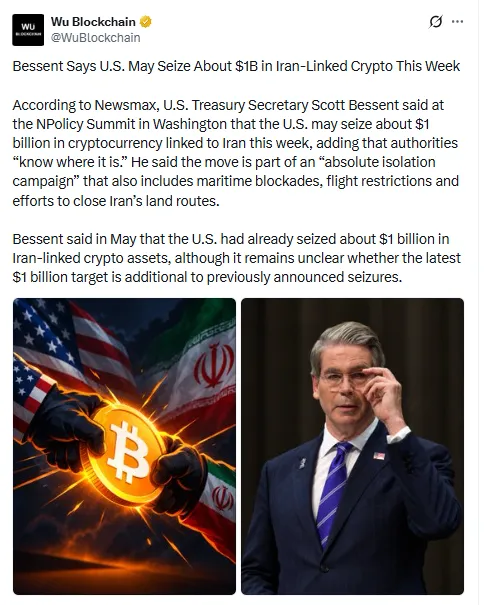
Source: Wu Blockchain
The Treasury Department had not officially announced the completion of the proposed seizure in the supplied reporting. Consequently, the $1 billion figure represents a potential enforcement action rather than a confirmed transfer of confiscated funds.
The latest announcement also leaves questions about the cumulative value of cryptocurrency taken or restricted by U.S. authorities. In May, Bessent said the government had seized approximately $1 billion in Iranian cryptocurrency, claiming officials had directly taken control of the wallets.
A Treasury statement issued shortly afterward cited an earlier estimate of nearly $500 million. The difference between the two figures was not resolved in the supplied information, and Bessent’s October remarks did not establish whether the latest $1 billion target represents additional assets.
Earlier Sanctions Targeted Iranian Crypto Exchanges
Washington has also pursued cryptocurrency-related enforcement through wallet restrictions and sanctions against exchanges. In July, the Treasury Department announced sanctions that resulted in approximately $130 million being frozen in Iran-linked cryptocurrency wallets.
Onchain analyst Specter connected that action to four Tron addresses holding roughly $131 million in USDT. Tether blacklisted the addresses, according to the supplied reporting. The distinction matters because freezing assets through wallet restrictions does not, by itself, establish that the government has seized ownership of the funds.
The United States has separately sanctioned several Iranian cryptocurrency exchanges. Measures announced in June targeted Nobitex, Wallex, Bitpin and Ramzinex, while August brought sanctions against Shelbit and Aban Tether.
In September, Washington targeted BitBank over allegations that it transferred hundreds of millions of dollars in bitcoin. The allegations formed part of the broader enforcement campaign against Iranian financial networks, but the supplied material does not establish that every transaction involving the named exchanges was unlawful.
U.S. Expands Pressure Beyond Cryptocurrency
Bessent said the proposed seizure forms part of a wider effort to restrict Iran’s financial and geographic connections. He described maritime blockades, limits on international flights and efforts to close overland routes through neighboring countries as elements of the administration’s approach.
Sanctions against 17 ships carrying oil from Iran were announced by the Treasury Department on October 8. The measures were associated with Operation Economic Outcast, which Washington launched in August to reduce Iranian revenue.
Bessent also said the United Arab Emirates and Oman were cooperating with Washington, while the administration was working with Pakistan and Turkey to restrict land routes into and out of Iran. These statements outlined the administration’s stated strategy, but the supplied information does not independently establish the full implementation or results of each measure.
The cryptocurrency proposal therefore sits alongside actions directed at shipping and other channels through which Iran conducts international economic activity. Bessent said the administration had moved beyond its earlier maximum-pressure policy toward what he called absolute isolation.
Reports Detail Iran’s Cryptocurrency Activity
Data provided by blockchain analytics companies offer further insight into the U.S. concern regarding crypto transactions made by Iran. According to Chainalysis, the crypto activity of Iran was higher than $7.78 billion of transaction volume in 2025 in times of financial instability and sanctions.
Moreover, according to Chainalysis, wallets associated with Iran’s Islamic Revolutionary Guard Corps accounted for over 52% of the country’s crypto activity in Q4 2025. Chainalysis detected more than $3 billion of transfers to those wallets in 2025.
Separately, TRM Labs recorded more than $3.84 billion in transfers between CoinEx and sanctioned Iranian entities over seven years. Its analysis also identified approximately 6.2 million blockchain transfers worth about $2.7 billion between CoinEx and Nobitex.
TRM Labs further tracked roughly $67 million in transfers from Iran’s central bank to CoinEx-linked addresses across several blockchains between June 2025 and June 2026.