KEY INSIGHTS
- The aggregator hooks of Uniswap are connected to external sources of liquidity on both Ethereum Base and Robinhood Chain.
- Uniswap v4 looks at external prices and executes swaps via one transaction for its users.
- External transactions make it possible for the protocol to earn fees which are then used to burn UNI tokens according to the new system.
Uniswap Aggregator Hooks were released by Uniswap Labs on October 22, 2026, on Ethereum, Base, and Robinhood Chain. The feature integrates sources including Fluid, Curve, and PancakeSwap through the Uniswap web app and application programming interface (API).
According to Uniswap Labs, the update extends the protocol’s trading routes beyond its own liquidity pools, while transactions routed through external sources generate protocol fees that contribute to UNI token burns.
The project is based on a plan set forth in the UNIfication proposal by Uniswap back in November 2025. Additionally, it follows an earlier implementation on Tempo, a payments-oriented blockchain created by Stripe and Paradigm, which first released an aggregating hook back in March 2026.
How Uniswap Aggregator Hooks Connect External Liquidity?
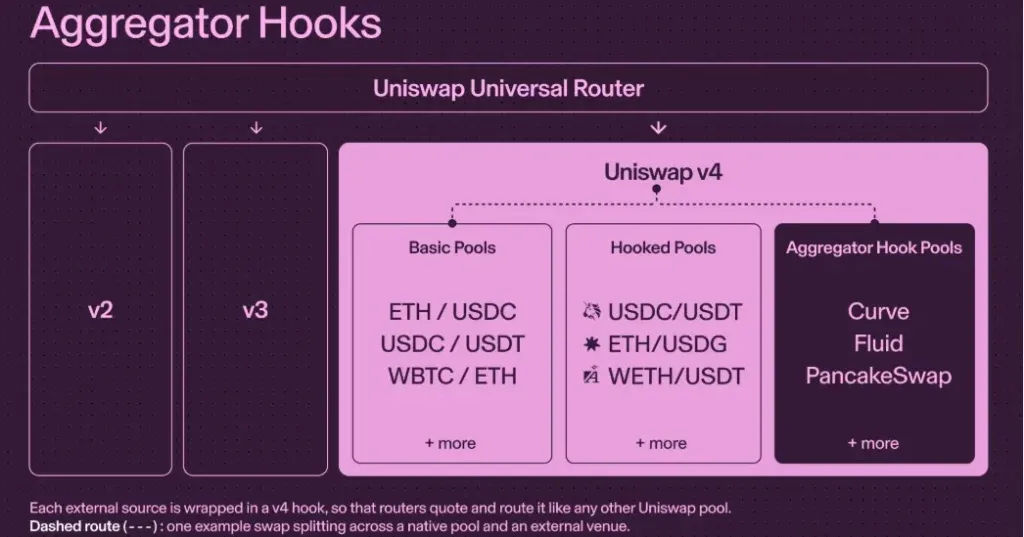
Uniswap Aggregator Hooks use the customization features introduced with Uniswap v4 to make liquidity held on other platforms accessible to the protocol’s routing system. Instead of limiting swap routes to liquidity within Uniswap’s own pools, the mechanism allows external sources to be considered alongside them.
Source: Uniswap
The Uniswap v4 hooks enable developers to implement custom logic in the liquidity pools. Aggregator hooks are applied by developers for external liquidity sources, which make the external liquidity source look like a Uniswap v4 pool to the router. This integration makes the external source available within the protocol’s existing swap-routing framework.
According to Uniswap Labs, the router obtains updated quotes from connected sources and evaluates available routes when processing a swap. It can compare prices across Uniswap pools and external platforms before selecting a route for the transaction.
The resulting swap settles in a single transaction, according to the company’s description. This arrangement allows the routing system to combine liquidity from different sources without requiring users to select each external platform manually.
The feature is available through the Uniswap web app and API on Ethereum, Base, and Robinhood Chain. Uniswap Labs said additional blockchain support is planned, although the supplied announcement does not specify a timeline for further integrations.
External Sources Become Part of Uniswap’s Routing System
Fluid, Curve, and PancakeSwap are among the external liquidity sources available at launch. Uniswap Labs’ announcement states that seven sources are available across the supported networks, collectively covering more than 90% of decentralized exchange activity on those chains.
The company stated that external aggregators are automatically included in case users switch via the Uniswap website. Additionally, developers have the ability to access the routing capability via the Uniswap API, and therefore applications using the interface can route trades through Aggregator Hooks.
Support differs by network. Ethereum mainnet, Base, and Robinhood Chain are accessible through both the web app and API, according to a Uniswap Labs spokesperson quoted by The Block. Tempo, where the first aggregator hook launched in March 2026, is supported through the web app.
Uniswap Labs has described its protocol as the largest decentralized exchange by trading volume, reporting more than $4.5 trillion in cumulative volume in the launch material. Its broader company description cites more than $4.6 trillion in all-time volume.
The company has also acknowledged that liquidity continues to exist outside its ecosystem despite the volume already processed through Uniswap. Aggregator Hooks address that situation by incorporating external sources into the protocol’s routing process rather than requiring all available liquidity to originate from Uniswap pools.
Uniswap Aggregator Hooks Introduce Protocol Fees on External Trades
The feature also connects external liquidity routing to Uniswap’s protocol-fee mechanism. Uniswap Labs said swaps executed through external liquidity sources will pay protocol fees, with the resulting fees contributing to UNI token burns.
Token burns remove tokens from circulation. Under the announced arrangement, trading activity routed through connected external sources can therefore contribute to the protocol’s existing burn mechanism, rather than generating activity exclusively through Uniswap’s own liquidity pools.
However, the supplied announcement does not provide a projection for additional fee revenue from the launch. It also does not quantify how much UNI could be burned through external-source transactions. The extent of any contribution will depend on actual activity routed through the feature, but the available material does not establish a measurable outcome.
The development follows the UNIfication proposal introduced in November 2025, which outlined plans to turn Uniswap v4 into an aggregator. The October launch puts that approach into operation across three networks, alongside the earlier Tempo implementation.