
Pons offers a crypto token launch and exchange platform on Robinhood Chain that eliminates various manual processes that are usually required for token creation. Pons offers an application through which one can create tokens from connected wallets by dealing with the contract and liquidity process.
Pons is designed such that token launches and liquidity in decentralized exchanges go hand in hand, and Robinhood Chain facilitates the blockchain process.
The difference between the two is critical. The Pons application is the one that launches tokens, while the Robinhood Chain is a Layer 2-compatible blockchain of Ethereum built on Arbitrum. According to the Robinhood documentation, chain ID 4663 is the chain ID number for the blockchain with ETH being the gas coin.
How Ponslauncher Robinhood Chain Works?
Pons is used as a non-custodial launchpad, which means that it is not necessary for the app to own the wallets or private keys of the user.
The process of creating a token involves the provision of the following information: name of the token, symbol, logo, description, links, and fee receiver. The launch mechanism takes care of everything else, starting from the underlying contract to the liquidity setup. The current launch mechanism employs a fixed token supply with a launch fee of 0.0005 ETH.
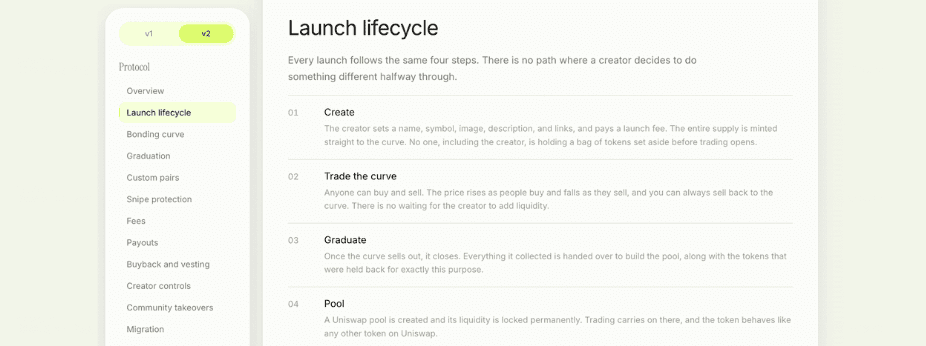
Pons launchpad token creation, Source: BingX
The launch process is meant to link the token that is just created to decentralized exchange liquidity. The current documentation of the launch mechanism shows that WETH is the token trading pair.
Such an approach suggests that the transaction takes place via a liquidity pool rather than a regular order book. Liquidity influences the way transactions impact the token price on the market, and large transactions have a bigger influence in case of low liquidity.
Liquidity and Token Trading
Liquidity is an important factor in the Pons launch since the liquidity in the pool is needed for trading purposes. Pons documentation states that liquidity is automatically locked rather than being left in the creator’s wallet for later withdrawal.
A liquidity lock does not ensure that a token maintains demand or value. Pons warns that tokens launched through the platform can experience volatility, become illiquid or lose all value.
The platform also warns users to verify contract addresses. Token names, symbols and images can be copied, so those details alone do not establish whether a particular token is the intended asset.
Pons should also be distinguished from PONS, which is a separate crypto asset associated with the broader ecosystem. A token created through Pons is not automatically affiliated with PONS or Robinhood.
Pons V1 and V2 Launch Systems
The publicly available Pons contract repository documents two versions of its launch system. V1 uses a Uniswap V3 pool from the start, while V2 introduces a bonding-curve mechanism before transitioning to a Uniswap V4 liquidity pool.
Under V2, trading initially takes place through a bonding curve. The formula calculates token pricing based on a mathematical relationship established between the token supply left in the curve and the quote assets added to the curve.
Once the launch reaches its graduation condition, the bonding curve closes. Its reserves are then used to establish a Uniswap V4 liquidity position. The V2 documentation states that this liquidity position is permanently locked.
The two versions mean that not every token launched through Pons necessarily follows the same trading mechanism. Users therefore need to check the relevant factory and launch configuration when reviewing a specific token.
Pons and Robinhood Chain Compared
| Component | Function |
| Pons | Launches and supports token trading |
| Robinhood Chain | Records transactions as the underlying Layer 2 |
| Wallet | Signs and submits transactions |
| Uniswap | Provides decentralized exchange liquidity infrastructure |
| ETH | Native gas asset on Robinhood Chain |
Robinhood Chain’s role is therefore separate from the Pons application. Using Pons does not make a token an official Robinhood product.
Ponslauncher Robinhood Chain combines a wallet-based launch application with an Ethereum-compatible Layer 2 infrastructure.
The platform handles token contract and liquidity setup while transactions are recorded on Robinhood Chain. Their system includes direct launches via Uniswap V3 as well as a V2 bonding curve approach that transitions into liquidity of Uniswap V4, and so the exact launch configuration becomes an essential aspect when analyzing tokens that were issued via Pons.
FAQs
What is Pons Launchpad?
Pons is a non-custodial solution for creation and exchange of tokens on Robinhood Chain, where transactions get approved by users themselves and not delegated to Pons’ custodian.
Is Pons affiliated with Robinhood?
Both Pons and Robinhood Chain should be regarded separately, with Robinhood providing a blockchain and Pons being an app running on it. Token that gets issued via Pons can’t be considered a Robinhood token automatically.
Which blockchain does Pons work on?
Pons operates on Robinhood Chain, which is an Ethereum-compatible Layer 2 with chain ID 4663 and ETH as a native gas asset.