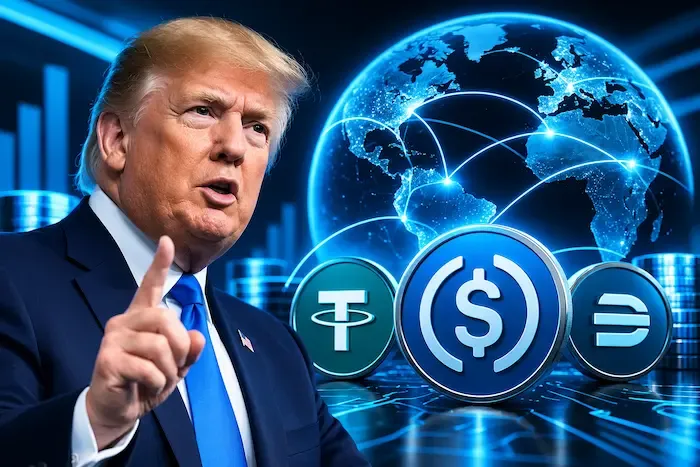
- Trump said stablecoins could settle some global payments in seconds rather than weeks or months.
- Trump linked stablecoins to a broader vision of blockchain-based financial infrastructure worldwide.
- Trump’s crypto agenda faces political scrutiny as lawmakers debate stablecoin rules and ethics concerns.
President Donald Trump said Oct. 3 that Trump stablecoins could change how money moves globally, arguing that transactions using stablecoins could settle within seconds rather than taking weeks or months under some traditional financial processes. He made the remarks during the Republican Midterm Convention in Dallas while describing a broader financial system built on blockchain infrastructure.
Trump also pointed to a future in which more financial activity takes place on-chain. His comments add to his administration’s broader support for digital assets and stablecoins as the United States continues developing its cryptocurrency regulatory framework.
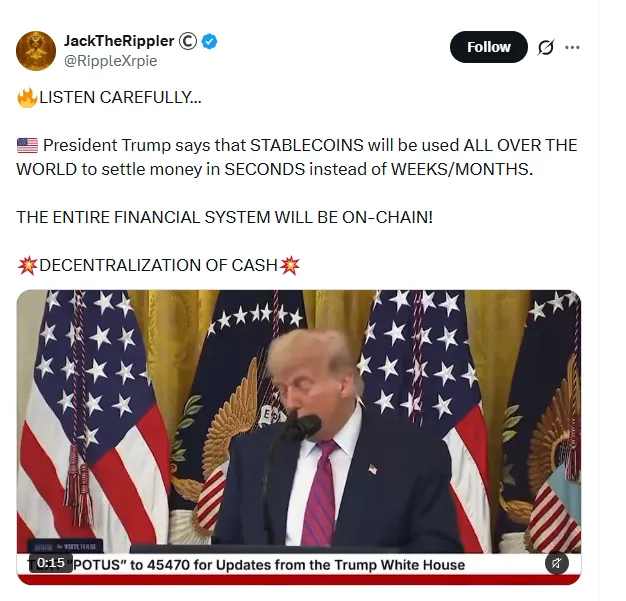
Source: RippleXrpie
The remarks place stablecoins within a wider policy agenda that includes the GENIUS Act and the proposed CLARITY Act. The GENIUS Act established a federal framework for payment stablecoins, while the CLARITY Act has faced opposition and failed to advance in the Senate.
Trump Stablecoins Focus on Faster Settlement
Trump’s comments centered on the time required to move money through existing financial systems. He said stablecoins could allow transactions to settle in seconds, contrasting that with processes that can take weeks or months.
He also described blockchain as potential underlying infrastructure for the financial system. Rather than limiting blockchain applications to cryptocurrency trading, Trump’s remarks presented the technology as part of a broader financial architecture.
The comments reflect the administration’s stated interest in expanding digital asset use in the United States. Trump has previously promoted the goal of making the country a major center for cryptocurrency activity, while his administration has pursued regulatory changes affecting the industry.
The stablecoin policy framework is still being implemented. Recent reporting says the GENIUS Act was enacted in 2025, but additional rules from federal regulators are needed before the framework is fully operational.
Dollar-Backed Stablecoins Have Strategic Role
The Washington Post reporting on recent times has indicated that backing of the U.S. dollar by stablecoins is also part of an overall strategy by Trump to ensure American financial dominance.
From this perspective, greater usage of dollar-backed stablecoins will lead to higher demand for U.S. Treasury securities as stablecoin issuers need to hold reserves. Other reporting has similarly connected the GENIUS Act’s reserve requirements with demand for short-term Treasuries.
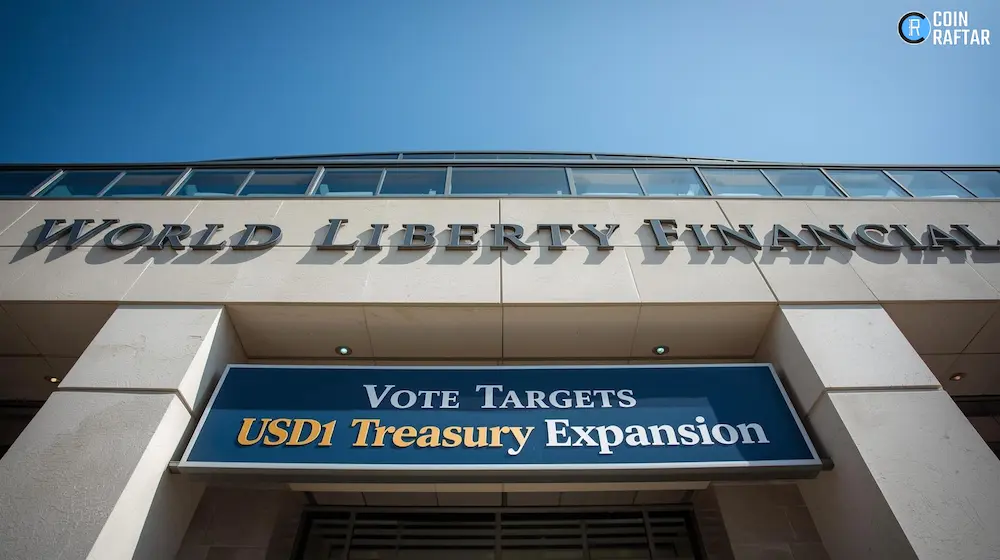
Trump’s broader crypto agenda has also included strategic digital asset reserves and efforts to position the United States as a leading jurisdiction for digital assets. His family-linked ventures include World Liberty Financial and its USD1 stablecoin.
Trump Crypto Interests Face Political Scrutiny
The debate extends beyond stablecoins to Trump’s involvement with the TRUMP memecoin. Fight Fight Fight, the promoter of the token, is marketing a Nov. 22 dinner at Trump National Golf Club outside Washington, with Trump advertised as the featured speaker.
According to the supplied promotional details, access is tied to a time-weighted leaderboard of TRUMP token holders. The top 185 holders receive seats, while the top 29 receive access to a VIP reception and the top four receive an 18-karat Trump-branded gold watch.
Democratic lawmakers have criticized the event and said a Democratic victory in either chamber of Congress could lead to investigations into Trump family business dealings. Sen. Richard Blumenthal and Sen. Chris Coons have publicly characterized Trump’s crypto-related activities as an ethics concern.
The White House has directed questions about the dinner to Fight Fight Fight and has said Trump’s portfolio is independently managed by third-party financial institutions.
CLARITY Act Debate Adds to Stablecoin Discussion
Trump’s stablecoin comments come as lawmakers continue debating the broader rules governing digital assets. The Senate failed to advance the CLARITY Act after a vote fell short of the 60 votes required to move forward.
Ethics provisions connected to Trump’s crypto businesses were among the disputed areas surrounding the legislation, alongside issues involving stablecoin rewards and protections for developers.
A CoinDesk survey cited in the supplied material found that 62% of registered voters did not trust the Trump administration to handle crypto regulation, while 73% opposed senior officials holding crypto business interests.
Separately, in an X post, Sen. Cynthia Lummis claimed Trump had appointed a “CRYPTO Czar” and planned to name a “SUPER INTELLIGENCE Czar.” The account was identified as a satire commentary account, so those claims should not be treated as evidence of actual appointments.