

Ether.fi is expanding beyond liquid staking and crypto payments with a branded U.S. dollar stablecoin designed to bring dollar-denominated balances deeper into its product ecosystem.
The company announced ether.fi USD on Oct. 6, with Ethena providing the infrastructure for reserves, minting, redemptions, and compliance. The arrangement gives ether.fi its own dollar token while leaving much of the underlying stablecoin infrastructure to Ethena.
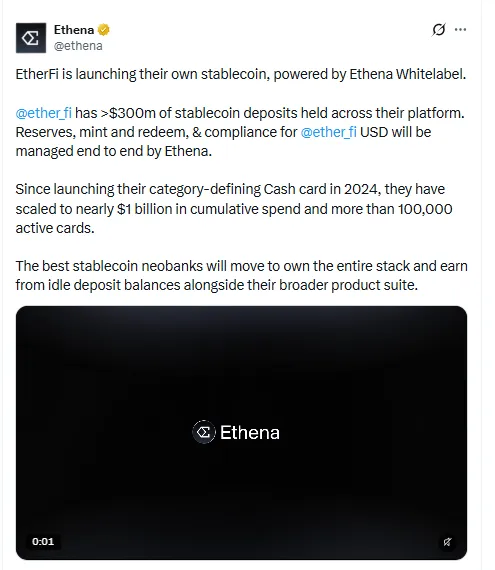
The announcement is important because ether.fi has already accumulated a considerable amount of stablecoin balances and an emerging payment business. Ethena said that ether.fi has a stablecoin balance exceeding $300 million and that its Cash card had spent nearly $1 billion since its introduction in 2024.
What Is ether.fi USD?
Ether.fi USD is a planned U.S. dollar-denominated stablecoin built through Ethena Whitelabel, Ethena’s stablecoin-as-a-service infrastructure. Instead of developing every part of the issuance and reserve system internally, ether.fi is using Ethena’s existing infrastructure while presenting the resulting dollar token under its own brand.
According to Ethena, it will be overseeing the entire operation for the stablecoin, from reserve management and minting to redemptions and compliance. This, in turn, allows ether.fi to incorporate the token in its solutions without having to develop its own operational stack.
Source: Ethena
Nevertheless, there are still a number of significant unknowns. Neither company has specified when ether.fi USD will become available, which blockchains will support it, what assets will make up its reserves or what the token’s specific redemption terms will be. Ether.fi also has not said whether existing stablecoin balances will automatically move into the new token or whether customers will need to opt in.
Why Is Ether.fi Launching a Stablecoin?
The move is closely connected to the money already circulating through ether.fi’s products. The company says its platform holds more than $300 million in stablecoin balances, creating a large pool of dollar-linked assets that could potentially be used across its ecosystem.
Ethena described the broader model as one in which crypto-focused financial platforms can capture more of the economics associated with balances held within their products. Rather than simply supporting external stablecoins, a platform can use a branded stablecoin throughout its own services.
For ether.fi, that could connect its stablecoin infrastructure more closely with Cash, its card and financial-services platform. Its existing Cash products already allow customers to spend supported stablecoins directly. Ether.fi’s documentation also describes a Borrow mode in which users can borrow against eligible assets rather than selling them to fund purchases.
The new token could therefore become another layer connecting stablecoin balances, payments and other ether.fi products. Still, the companies have not disclosed how revenue from the arrangement will be divided or whether ether.fi USD holders will receive any yield.
How Does Ethena’s Whitelabel Model Work?
Ethena Whitelabel allows another company to launch a branded dollar token while using Ethena’s infrastructure for core stablecoin functions. According to the supplied material, partners can choose from approved stablecoins and determine an allocation based on their risk and regulatory requirements.
The model can therefore produce different reserve structures for different branded tokens. Ethena’s own USDe, for example, uses a synthetic-dollar model involving crypto assets and offsetting short futures positions. USDtb follows a different structure and is described by Ethena as being backed by fiat dollars and BlackRock’s BUIDL fund.
The reason is that the term “stablecoin” does not indicate the reserve type used by the stablecoin itself. It is possible for two stablecoins to aim at one dollar worth but have entirely different underlying assets and other factors.
Ether.fi USD vs. Existing Ether.fi Stablecoins
Ether.fi already supports stablecoins such as USDC within its Cash ecosystem and has also offered products involving other dollar-linked assets. Its current documentation shows that Cash can use supported stablecoins for direct spending, while borrowing products can use eligible assets as collateral.
Ether.fi USD would be different because it would be a branded stablecoin associated directly with the ether.fi ecosystem rather than simply an external stablecoin supported by its products.
That would allow ether.fi more control over dollar flows from one of its applications to another. However, there are also other questions concerning reserves, liquidity, redeeming and the relationship between ether.fi and Ethena.
What Remains Unknown?
The most important unanswered questions concern the token itself. Ether.fi and Ethena have not yet disclosed the final reserve mix, supported networks, launch date or detailed redemption mechanics.
Those details will determine how users should understand the risks of ether.fi USD. The reserve assets, redemption process and liquidity of a stablecoin could influence the reliability of the stability of the stablecoin towards its dollar goal, especially during times when the market is under stress.
In addition, the collaboration implies that it will be important for users to differentiate between the products offered to customers through ether.fi and the underlying system run by Ethena, as the latter company provides several crucial services such as reserves and redemptions.