
KEY INSIGHTS
- CFTC clears stock-linked perpetual futures for regulated U.S. exchanges.
- Equity perps will operate under joint CFTC and SEC oversight.
- No exchanges, supported stocks, or official trading launch dates announced.
The U.S. Commodity Futures Trading Commission (CFTC) has cleared a regulatory path for perpetual futures tied to individual stocks, allowing eligible exchanges to list the contracts for the first time.
Chairman Michael S. Selig announced the decision Tuesday, November 3, 2026, saying the products had been deemed approved under existing rules for security futures. The move extends a derivatives structure widely used in cryptocurrency markets into traditional securities, with oversight shared by the CFTC and Securities and Exchange Commission (SEC).
The decision does not mean trading has begun. Selig’s statement named no participating exchanges, identified no stocks and set no launch date. Those details are expected from designated contract markets that choose to list the products.
The contracts, known as equity perpetual futures or equity perps, will be subject to the Commodity Exchange Act, federal securities laws and the regulatory frameworks of both agencies. Exchanges must meet applicable registration requirements before listing them.
Equity Perpetual Futures Fall Under Joint CFTC-SEC Rules
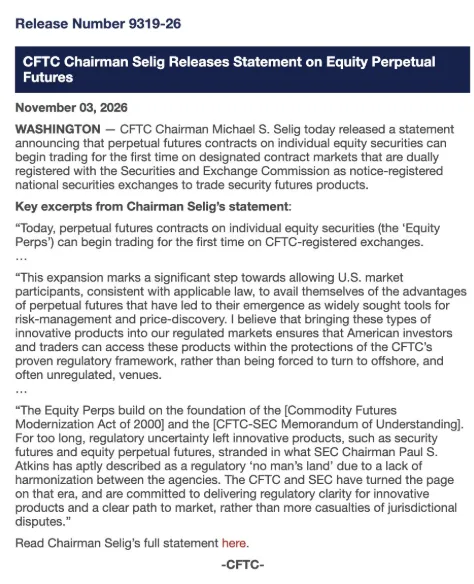
The CFTC deemed the contracts approved under Commission Regulation 40.3 as security futures products. Their legal basis is the Commodity Futures Modernization Act of 2000, which established a framework for joint regulation of products involving securities and commodities.
Source: Generation Infinity
An exchange seeking to list equity perps must be registered with the CFTC as a designated contract market. It must also hold notice registration with the SEC as a national securities exchange for security futures. This arrangement places the products under both regulators.
Selig linked the decision to a memorandum of understanding signed by the CFTC and SEC on March 11, 2026, to guide coordination between the agencies. He also cited SEC Chairman Paul S. Atkins’s description of security futures as having been left in a regulatory “no man’s land” because of insufficient harmonization.
The approval applies the existing framework to perpetual contracts linked to individual equities. However, it does not identify qualifying exchanges or when particular contracts will become available.
How Perpetual Futures Work
Unlike conventional futures, perpetual contracts have no fixed expiration date. Traders holding long and short positions exchange periodic funding payments intended to keep contract prices aligned with the underlying asset’s spot price.
The structure is established in cryptocurrency derivatives markets, where much of the activity has taken place on platforms outside U.S. jurisdiction. Such contracts allow traders to speculate on the price of an asset without actually owning it. They often involve leverage, which can amplify both gains and losses.
DeFiLlama data cited in the source material put overall perpetual-futures trading volume above $630 billion over the previous month. That figure describes the broader market, not trading in the newly approved equity contracts.
The U.S. decision follows an earlier approval involving bitcoin. On May 29, 2026, the CFTC approved Kalshi’s BTCPERP, described as the first bitcoin perpetual futures contract listed in the United States. Kalshi launched it soon afterward and added gold and silver perpetuals in September.
Selig described the equity approval as an extension of that step, taking the instrument beyond digital commodities and into traditional securities.
Legal Disputes and Offshore Security Concerns
The regulatory treatment of perpetual futures is already being challenged. CME Group sued the CFTC in June over its approval of Kalshi’s bitcoin contract. CME argued that a contract based on exchanged funding payments should be classified as a swap under the Dodd-Frank Act, not a future. The case remains pending.
Equity contracts bring the SEC more directly into the picture because the underlying assets are securities. The CFTC says the products fall under both agencies’ frameworks, although the supplied material does not report a separate legal challenge to the equity approval.
The announcement also followed a major theft from Binance. On October 29, attackers drained about $6.3 billion from the exchange’s hot wallets in roughly 20 minutes. TRM Labs and Chainalysis linked the attackers to North Korea’s TraderTraitor group. Binance reopened withdrawals on Sunday and said it had replenished about 95% of the affected assets.
In an October 30 CNBC interview, Selig cited the incident while criticizing offshore exchanges for lacking safeguards found in U.S. financial markets. He also pointed to an October CFTC proposal for a voluntary federal registration path for crypto exchanges, including cybersecurity, proof-of-reserves, and custody requirements. Selig said Congress would need to act before the agency could make registration mandatory.
For equity perpetual futures, the immediate result is a regulatory route to listing, not a confirmed launch. Exchanges must satisfy the dual-registration conditions, while the stocks, venues and trading dates remain undisclosed.
FAQs
What are equity perpetual futures?
They are contracts linked to individual stocks that have no fixed expiration date and use periodic funding payments to help align contract prices with spot prices.
Which agencies oversee equity perpetual futures?
The CFTC and SEC share oversight under the Commodity Exchange Act, federal securities laws and their respective regulatory frameworks.