
Key Insights:
- Tethers disclosed exposure is still than 0.034% of assets even though the exact balance in EQIBank is not known.
- US prosecutors are asking for 84.2 million dollars while EQIBank says 89 million dollars in funds were taken.
- The dispute, between Tether and EQIBank shows how banking restrictions can make it hard to access reserves without harming the stability of the stablecoin.
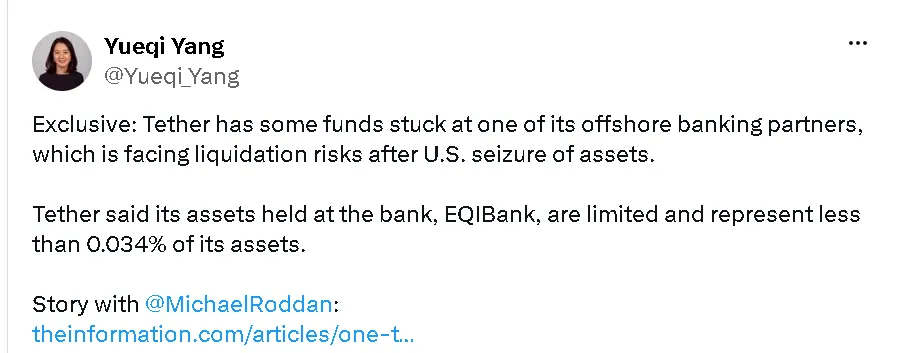
Tether EQIBank exposure continues to be less than 0.034% of group assets, with the stablecoin issuer stating that money is still held at its offshore banking partner. The disclosure follows a US seizure targeting approximately $89 million linked to EQIBank, which warns that losing access could threaten its survival.
The information reported the banking relationship on September 24, citing Tether’s use of EQIBank for wire transfers connected with USDT purchases and redemptions. Tether subsequently confirmed the relationship but said it had no knowledge of alleged misconduct involving payment processor Capstone Ltd.
The dispute raises questions about reserve accessibility as EQIBank challenges the US government’s forfeiture action in federal court.
Tether limits exposure as banking dispute escalates
Tether said to The Information that the assets kept at EQIBank are, than 0.034% of all the assets the company owns.. The company did not share the exact amount that was put into the bank.
Its June 30 financial figures provide an upper-bound estimate of the exposure. Tether reported $187.75 billion in total assets, making the disclosed percentage equivalent to approximately $63.8 million.
The calculation does not establish Tether’s actual deposit balance or confirm how much remains inaccessible.
A spokesperson also denied knowledge of the alleged conduct involving Capstone. Tether said the US Department of Justice’s allegations concerned activities outside its knowledge. Meanwhile, EQIBank’s legal dispute has developed around funds seized from accounts associated with Capstone at major US financial institutions.
US prosecutors pursue $84.2 million in assets
EQIBank filed a property-return motion on June 29 in the US District Court for the Eastern District of California. The bank sought to recover funds seized through accounts connected with Capstone.
Later on July 15, prosecutors filed a civil forfeiture complaint. Court documents show that prosecutors are seeking to forfeit about $84.2 million, in assets.
The September 14 court order lists approximately $79.11 million from a Wells Fargo Securities account held in Capstone’s name. Another $1.86 million came from a Wells Fargo Bank account, while approximately $2.06 million involved JPMorgan Chase.
The complaint also identifies cryptocurrency holdings, including 1.12 million USDT and another 54,578.45 USDT.
EQIBank, however, puts its claimed loss at approximately $89 million. The lender says the seizure represents around 80% of its monetary holdings and could force liquidation. The two figures reflect different filings and claims, rather than a final determination of ownership.
Court proceedings leave depositor recovery uncertain
On July 16, District Judge Dale A. Drozd denied EQIBank’s property-return motion after prosecutors initiated the forfeiture action. The court declined to exercise equitable jurisdiction over the return request.
The decision did not determine whether EQIBank owns the seized funds or whether the government can permanently retain them.
On September 16, the judge ordered the related proceedings assigned to the same district and magistrate judges. However, the court did not consolidate the cases.
A separate September 14 order requires prosecutors to publish forfeiture notice for 30 consecutive days. Interested parties must follow the applicable claim procedures before litigation advances.
EQIBank maintains that it owns the money and argues that authorities have not identified the bank as an investigation target.The case, however, is not settled yet in court regarding their ownership claims. As such, the future of Tether’s recovery hinges on the court case and how assets can be divided.
The implications of the overall stablecoin market will be discussed, while the reserve strategy will be reserved. In its June attestation, Tether showed $183.64 billion of liabilities and $4.11 billion of an excess reserve buffer. As of the quarter-end, USDT issuance was close to $184.6 billion.
The company also announced an operating profit of about $1.5 billion in the second quarter. It has significant holdings of US Treasuries and short-term liquid instruments in its reserves. At the reported exposure cap, EQIBank is only 1.6% of Tether’s excess reserves for the month of June.
But the conflict provides a good example of the difference between reserve value and the availability of cash. Banking partners are key to the management of transfers and redemptions and to conventional cash operations for stablecoin issuers.
In March 2023, Circle had a comparable counterparty issue after $3.3 billion of reserves in the form of USDC were held at Silicon Valley Bank. The bank’s failure briefly caused an issue with the dollar peg, before the authorities guaranteed deposits to the bank.
However, the case of Tether is different, and on September 25, no similar reaction in the markets was reported. The price of USDT remained close to the dollar level.
Conclusion
The Tether EQIBank dispute has not been resolved, as the lender is challenging the forfeiture, while Tether has not provided its exact deposit amount. The amount of exposure is disclosed, but the final result will decide the amount of material that Tether will be able to recover and when access will be re-opened.