
The Hong Kong authorities have issued laws that outline proposed licensing conditions for cryptocurrency enterprises engaged in dealing, advisory, portfolio management, and custody. The Virtual Asset Services Legislation (Amendment) Bill 2026 was gazetted on 20th November and is due to be read for the first time on the 2nd December 2026 at the Legislative Council.
The proposed regulations would extend the city’s existing virtual asset regulations to non-centralized trading platforms. Firms offering the four new services would have to be authorized by the Securities and Futures Commission (SFC) and/or registered with it, meet fit-and-proper requirements, and fulfill other requirements.
The bill also covers the traditional financial institutions, which must register with the SFC before conducting virtual asset services, as well as the stored value facility operators supervised by the Hong Kong Monetary Authority (HKMA).
The Hong Kong Crypto Licensing Bill addresses four services.
Under the proposed amendments to the Anti-Money Laundering and Counter-Terrorist Financing Ordinance, four new types of regulated virtual asset activities are added.
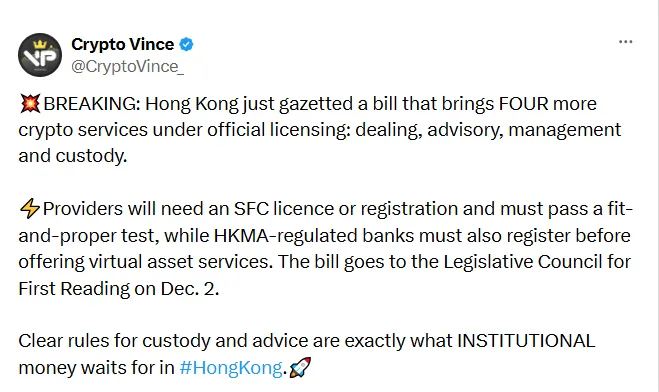
Source: Crypto Vince
The first is virtual asset dealing, which adopts a licensing arrangement similar to the SFC’s Type 1 framework. The second is on advisory services, which include businesses that offer recommendations on cryptocurrency investing. The third is for discretionary portfolio managers based on similar standards as Type 9 licensing.
The fourth category presents a new type of licensing regime for virtual asset custody providers. Unlike the other three categories, there is no one-to-one equivalent in the existing securities licensing system for custody.
The proposed arrangements would mean each category would have regulatory requirements appropriate to their activities. The expansion will see more companies in cryptocurrency transactions and investment services come under the SFC’s direct supervision.
SFC rules would also apply to banks and AI advisory services.
The plan for Hong Kong’s cryptocurrency licensing regime would include firms not just in the crypto sector.
The virtual asset service providers would have to secure SFC registration before providing virtual asset services, which is also applicable to banks and stored value facility operators already subject to the HKMA’s regulation. This would impose a new registration requirement for financial institutions that wish to offer cryptocurrency products/services.
The category also covers investment advice produced with the help of AI tools. The government’s consultation outcomes suggested that services that offer specific recommendations for cryptocurrencies might be caught within the scope of the license.
Copy-trading service and investment signals were among the activities that were deemed to be within the proposed requirements.
This framework does make a distinction, however, between investment advice and information. Factual market information would continue to be exempt from the advisory licensing requirements. There would also be a ban on software that automatically sorts information that’s available so you can research independently.
The consultation conclusions did not set a threshold for the exposure to virtual assets for portfolio managers. This requires managers with discretionary investment authority in a traditional securities portfolio and also a digital asset portfolio to be authorized under both regulations.
Report on the Consultation Process, Behind the Bill, Hong Kong
The bill is results of a two-step industry consultation process with the proposed regulatory categories.
The first consultation focused on virtual asset trading and custody. In August 2025, it closed with 101 submissions related to dealing and 93 submissions for custody.
The first idea that was considered by the regulators was to include advisory and management activities to the dealing framework. These activities were then broken down into individual categories after receiving feedback from industry.
A second consultation took place in December and was responded to by 51 people. The government’s findings, issued in May, found most respondents favored regulations similar to those imposed on traditional securities firms.
The structure of the proposed amendment bill was laid out in the consultation process, with a distinction between the conditions for advisory services and discretionary management services.
SFC and Government Officials Discuss the Regulatory Approach
The proposed architecture of the regulations is significant in expanding the framework of legal regulations for digital assets, said Christopher Hui, the Secretary for Financial Services and the Treasury of Hong Kong.
The strategy is “same activity, same risk, same rules,” he said, which means uniformity in similar financial activities.
SFC chief executive Julia Leung also called the proposal “an important step towards the full implementation of Hong Kong’s virtual asset regulatory framework. She added that a comprehensive supervision would not only help investors to be better protected but would also give companies clearer guidelines.
Conclusion
The proposed extension of crypto licensing in Hong Kong would be supported by formal licensing for services of dealing, advisory, management and custody. . The bill also introduces another registration condition for banks and operators of stored value facilities regulated by the HKMA, that provide virtual asset services.
The Bill was gazetted on the 20th of November, 2026, and will be read for the first time on the 2nd of December, 2026. The proposed requirements are subject to the legislative process.
Frequently Asked Questions
1) What are the four crypto services that will be regulated in Hong Kong?
The proposed law applies to virtual asset trading, virtual asset advisory or virtual asset discretionary portfolio management and custody.
- Who will be the license holder(s)?
The proposed framework will be governed by the Securities and Futures Commission, which will be responsible for authorizing and registering.
- To be registered by SFC?
Yes. The SFC would require virtual asset service providers, including banks and stored value facility operators, to obtain registration from the SFC before providing virtual asset services.