

KEY INSIGHTS
- Strategy stopped buying Bitcoin after five weeks of purchases, leaving them with 848,517 BTC valued at about $67.9 billion.
- Strategy has used $204.9 million for buying back STRC while its USD Cash was cut down to $242.4 million.
- The MSCI rules might affect the listing of the strategy in the index, therefore impacting the demand of their stock and fundraising activities.
Strategy paused its purchase of Bitcoin in the week ending October 25, 2026, using $204.9 million on buyback of STRC. This is per the firm’s filing with the U.S. Securities and Exchange Commission (SEC) on October 26, which saw the suspension of Bitcoin acquisitions for five straight weeks, with the total holding of the firm remaining at 848,517 BTC for the week ending.
The recent filing from Strategy also revealed that there were no sales of Bitcoin or any share issuance via its ATM program during the period under review. Instead, Strategy used its available USD Cash to buy back preferred shares, providing a different picture of its capital allocation activity during the week.
Strategies Continued to Hold 848,517 Bitcoins
Strategies maintained its Bitcoin holding of 848,517 bitcoins, which had been purchased for about $64.02 billion, inclusive of fees and charges. On average, Strategies paid $75,446 per bitcoin.
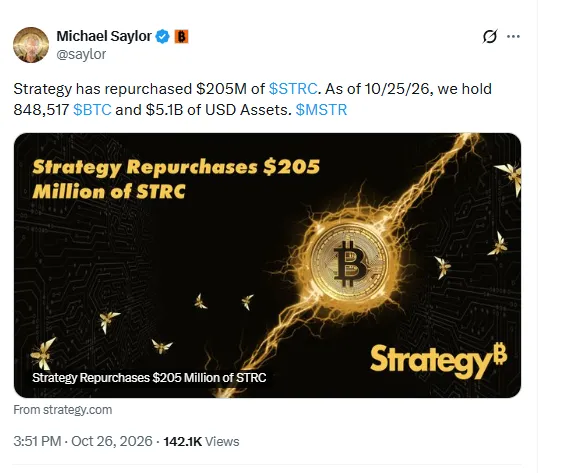
Source: Michael Saylor
The value of the asset according to the valuation provided is about $67.9 billion. The corporation’s Bitcoin holdings constitute over 4% of the total number of the coin in circulation.
The pause came after a couple of weeks of making smaller acquisitions. Strategy bought 250 BTC for around $21.5 million before purchasing an additional 267 BTC for around $22.1 million in the following week. The strategy also bought around $29 million of Bitcoin in the week when it had a $21 billion profit in the third quarter.
During the period from October 19 to October 25, there was no buying or selling of Bitcoin by the corporation. There is no clear reason provided for the suspension of the acquisitions program; hence, this should not be seen as any change in Bitcoin strategy by the company.
STRC Repurchases Account for $204.9 Million
While Bitcoin holdings remained unchanged, Strategy repurchased 2,068,459 shares of its STRC preferred stock for approximately $204.9 million. The company funded the transaction entirely from its USD Cash balance.
The latest repurchase exceeded the previous two reported weekly transactions. Strategy had spent approximately $193.1 million on STRC buybacks in the preceding week and $192.4 million in the week before that.
The company did not repurchase shares of its STRF, STRK or STRD preferred stocks during the latest reporting period. It also did not buy back its MSTR common stock.
Following the transaction, approximately $956.8 million remained available under Strategy’s $3 billion preferred stock repurchase program. The company also had $1 billion remaining under a separate program for repurchasing MSTR common shares.
Cash Reserves Continue To Be Vital For Strategy’s Financial Position
USD Cash and USD reserves held by Strategy were recorded at $4.83 billion and $242.4 million, respectively, as of October 25, 2016. Collectively, they sum up to around $5.07 billion.
The two reserves play distinct roles within the firm’s financial system. The USD reserve of the strategy is meant to provide funds for dividends to preferred shareholders and for paying interest on their debts. USD Cash is available for general corporate purposes, including Bitcoin purchases and share repurchases.
The STRC transaction reduced the USD Cash balance from approximately $447.3 million a week earlier to $242.4 million. The USD Reserve, meanwhile, remained at approximately $4.83 billion.
The distinction matters when assessing the company’s reported liquidity. Although Strategy retained billions of dollars in its designated reserve, the latest buyback drew on its separate cash balance rather than the reserve intended to support dividend and debt-interest payments.
MSCI Rules Add Another Consideration for Strategy
Strategy’s capital allocation decisions come as MSCI moves toward implementing rules that could affect companies classified as non-operating businesses. On October 15, the index provider finalized rules addressing companies whose balance sheets are dominated by a single asset.
Under the announced framework, affected companies could become ineligible for MSCI’s Global Investable Market Indexes following the November 30 market close. MSCI said it would publish the list of affected companies on November 11.
Strategy’s potential exclusion has drawn attention because index-linked funds may need to sell shares of companies removed from the benchmarks they track. Such selling could affect demand for MSTR stock, although the supplied information does not establish the eventual scale of any impact.
Steve Lee, co-founder of Neoclassic Capital, previously told The Block that reduced demand from index investors could bring Strategy’s shares closer to the value of its underlying Bitcoin holdings. He also linked that possibility to the company’s ability to raise capital through additional stock sales. Strategy Chairman Michael Saylor has criticized the proposed treatment, describing the rule as discriminatory.