
The shortfall between the amount of Social Security income and expenses is stressing the program’s reserves. The annual report of the Trustees for the Old-Age and Survivors Insurance (OASI) Trust Fund, which provides retirement and survivor benefits, says the fund will run out of its reserves in the fourth quarter of 2032, according to its 2026 projections. If no legislation is passed to change that, the continuing income would then pay for 78% of the scheduled OASI benefits.
Potential impact of the 2032 depletion projection on retirees
The projected depletion could affect both people approaching retirement and individuals already receiving Social Security payments.
In case there is no legislation to address the problem and the fund is exhausted by 2032, the ongoing income may cover 78 percent of the expected benefits of retirement and survivors.
This means that there might be a reduction in 22 percent in the amounts that people receive. This will be especially hard for those who are relying on their Social Security benefit to cover everyday expenses. The projection does not mean that benefits will stop completely.
What is the reason for the strain on US Social Security finances?
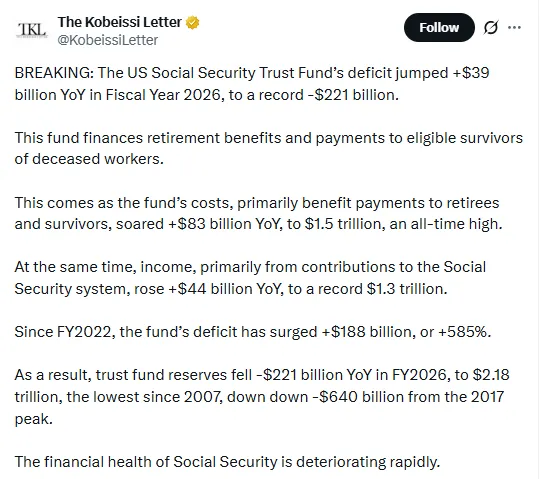
The bulk of Social Security’s revenue comes from payroll taxes, as well as taxes on benefits and interest on the securities in the Social Security trust funds. The Old-Age and Survivors Insurance and Disability Insurance (OASDI) funds received $1.449 trillion in 2025. Reserves were depleted as costs came to $1.610 trillion, $160.2 billion less than was on hand.
Source: Kobeissi Letter
Combined income is estimated at $1.493 trillion, while combined costs are estimated at $1.697 trillion for 2026, in the 2026 Trustees Report. The resulting shortfall of $203.6 billion will be expected to lead to a reduction in reserves. 2026 data is forecasted.
Most program spending is on benefit payments. In 2025 they accounted for 99.2% of all combined trust fund spending.
The significance of the 2032 date of depletion.
The 2032 estimate is for the OASI Trust fund only. It provides benefits for retirement, benefits for eligible surviving spouses and children of workers who are dead. The Disability Insurance (DI) Trust Fund is expected to have sufficient cash on hand to cover the scheduled benefits until 2100.
If it were completely depleted, this would not result in the complete cessation of payment of Social Security benefits. Payroll taxes would still be paid by workers and employers, and other income would still be flowing in. Now, though, according to the law, benefits would only be given what the resources available can provide.
The Trustees estimate that if they continue to receive the income they schedule, they will receive 78% of their scheduled OASI benefits, which is the equivalent of a potential 22% shortfall.
The combined OASI and DI trust funds have a later projected depletion date of 2034. From then on, the continuation income is projected to pay 83% of scheduled benefits.
Why is there a funding gap?
Since 2021, Social Security costs have been greater than the total income and are expected to continue on that trend over the 75-year period of the forecast. The program is largely run on a pay-as-you-go basis, meaning that the taxes paid by current workers are used to pay benefits to current recipients.
Context is provided through demographic projections. The number of retired persons is projected to grow approximately 60% in the next 50 years, according to the 2026 report. It also forecasts that in 2025, the ratio of workers contributing to Social Security taxes to beneficiaries will be 2.6 to 1, compared to 2.3 to 1 in 2035.
The Social Security payroll tax rate is 12.4% of covered wages, normally paid half by the employee and half by the employer. The full rate is paid by the self-employed.
Conclusion
The growing deficit in US Social Security finances is a consistent imbalance of income and expenditures. The Trustees project additional pressure, with varying retirement fund depletion dates and combined fund depletion date. The benefits are not not going to be eliminated, but the current law will not provide adequate income to continue to pay all scheduled benefits forever.
FAQs
Is Social Security going to cease payments in 2032?
If the continuation of income is projected, the OASI reserves are expected to be exhausted but scheduled benefits would be paid on an estimated 78% basis.
Does this 2032 affect all Social Security benefits?
No. It is applicable to fund for retirement and survivors. The combined OASI and DI reserves are expected to be exhausted in 2034.
Can Congress make a difference?
Yes. The projections are based on the assumption that law will be unchanged. Congress can make laws to solve the funding shortage.