A claim that the stock markets of over 42 countries have fallen into bear market territory has brought attention to falling international equity markets.
The reported figures identify substantial losses across Europe, Asia, the Middle East, Africa and Latin America, with Cyprus, Iceland, Bosnia and Herzegovina, Ukraine and Greece among the markets showing the largest stated declines.
However, looking at the data from the market we find that it is not all the same with some indices falling much lower than others. Indonesia’s Jakarta Composite Index is down 44.9% from its 52 week high with South Korea’s KOSPI down 40.9%. These numbers show how much these markets are under pressure but not all 42 countries.
Understanding the Global Bear Markets
A bear market refers to a stock index or market that has fallen by 20% or more compared to its recent high.
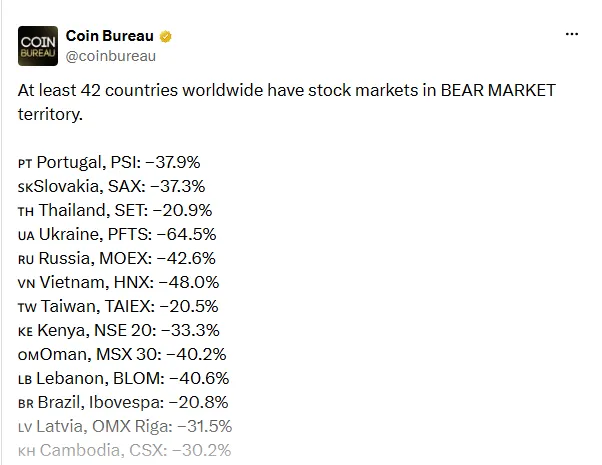
Source: Coin Bureau
The list shows 43 countries with losses between 20%-90%+. However there is no mention of when these losses were measured and therefore we do not know if they are down from their highest values ever or a recent high.
This is an important difference between international markets. An overall downward trend can be seen compared to a bearish market.
The Cyprus General Index was approximately 313 on 5th November 2026. This is much lower than the highest value of 5,574.91 reached in October 2007. We cannot be sure that all this loss has occurred due to the recent world downturn though.
Asian Markets had the biggest losses
Vietnam (HNX) – 48%, South Korea (KOSPI) – 46.1%, Indonesia (Jakarta Composite) – 45.2%.
More recent market data also indicate substantial weakness. Indonesia’s Jakarta Composite is currently down some 44.9 percent from its 52-week high whilst South Korea’s KOSPI is down 40.9 percent.
Japan also saw fresh weakness as the Nikkei 225 index dropped six percent on November 6 in trading on Friday taking it into bear territory. The index has now fallen more than 20 percent from its June high.
The Hang Seng in Hong Kong and the TAIEX in Taiwan were also featured but have not fallen as much as usual. Both have fallen less than the usual 20 percent from their 52-week high.
European Markets Face Uneven Pressure
In Europe, we saw losses in Iceland, Bosnia and Herzegovina, Greece, Montenegro, Serbia, Denmark, Portugal, Slovakia, and Finland.
The OMX Iceland All-Share index fell 76.3% in Iceland, while the SASX-10 index fell 75.2% in Bosnia and Herzegovina. The Athens General index fell more than 60% in Greece, and the MONEX index fell more than 60% in Montenegro.
The PSI index fell 37.9% in Portugal, while the SAX index fell 37.3% in Slovakia.
While these numbers show how varied the performance of European equity indices have been, it is important to know the time period they cover to compare them in terms of percentages.
Middle Eastern and African Markets Under Pressure
The Middle Eastern and African markets included in the reported figures also show considerable variation.
The TASI Index fell 51.9 percent, while the BLOM Index in Lebanon fell 40.6 percent, but stocks in Oman, Bahrain, Qatar and the United Arab Emirates were also included.
In Africa the NSE 20 index fell 33.3 percent in Kenya. The reported declines cover several different national exchanges and benchmarks. The available information, however, does not establish a single economic event responsible for all these movements.
Latin American Markets Add to the Reported Downturn
Other Latin American and Caribbean indexes are also down. Brazil’s Ibovespa is reported to be off 20.8% while Argentina’s MSCI Merval is 28.7% lower.
The Caracas IBC index in Venezuela is reported to be down 20.5%. Both the JSE Main in Jamaica and TTSE Composite in Trinidad and Tobago are down 27.3% and 34.5% respectively.
More recently, the Ibovespa index in Brazil is currently 20.4% below its 52 week high seen on November 5.
What do Global Bear Markets Mean for investors?
The downturn in 42 countries demonstrates how it is important to look at each individual index within each country.
With each exchange having their own historical high, time frame and market conditions, previous levels of drawdown shouldn’t be seen as an indication of a global financial crisis.
Moreover, each of the exchanges has varied historical performance, time frame and market conditions, which means that we should not assume historical drawdowns reflect a coordinated global financial crisis.
Clearly defined reference points are an important factor in evaluating international equities.
Frequently asked questions
What is a global bear market?
A global bear market is when one sees substantial falls on world stock markets.A market generally enters bear territory after falling at least 20% from a recent peak.
How many countries are reportedly experiencing bear markets?
The circulating figures identify 43 countries with stock market declines of at least 20%. However, the claim that all these markets are simultaneously in bear-market territory has not been independently verified.
What is the biggest drop in equity markets?
The largest drop in the list provided was Cyprus, who have a decrease of 94.4% in their CSE General Index.
Conclusion
The Global Bear Markets discussion reflects substantial reported declines across numerous international stock exchanges. Recent data shows that there has been significant weakness in several major indices such as KOSPI, Jakarta Composite and BIST 100.
However, it is also unconfirmed that 42 countries are currently in bear market territory. It will be necessary to ensure comparable time frames are used to determine how many countries are suffering.