
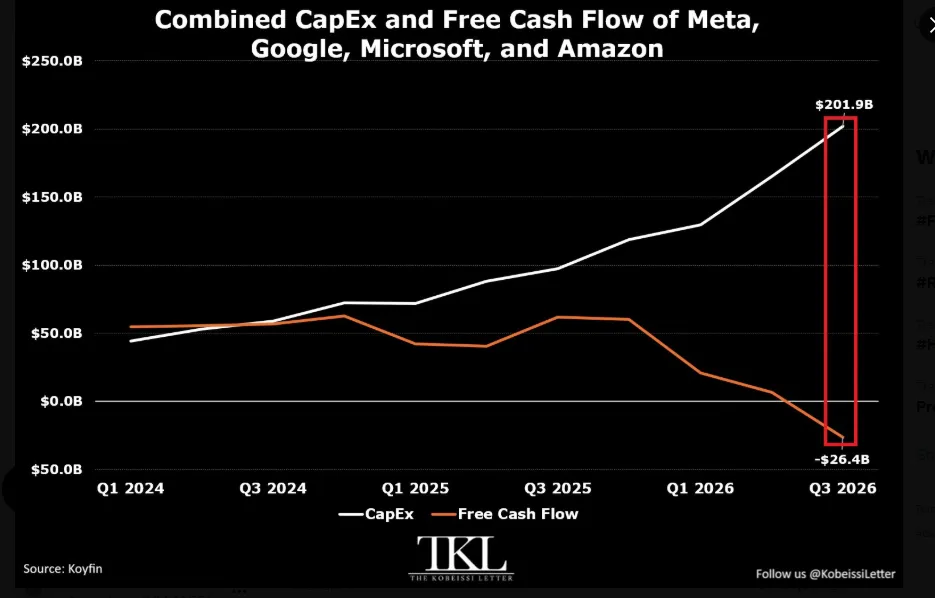
The highest amount of investment that Big Tech has made in terms of AI infrastructure was $201.9 billion in Q3 2026, with all four major players, Amazon, Alphabet, Meta, and Microsoft investing in computing and infrastructure.
Capex spending was $36.9 billion higher compared to the previous quarter, while free cash flow decreased to negative $26.4 billion. These figures show the impact of AI infrastructure on the finances of Big Tech companies.
The four companies have been making increasing investments in infrastructures that relate to their AI operations. However, the most recent financial results indicate an increasing gap between the amount of investment in infrastructure and the generation of money. Free cash flow is an important indicator in measuring the investment cycle.
AI Infrastructure Investments Amount to $201.9 Billion
The figure of $201.9 billion has experienced a considerable increase from the previous quarter and has more than doubled the investment made in infrastructure one year ago. The companies have increased their investment in infrastructure since the beginning of Q1 2024 due to the fast-growing infrastructure.
Source: The Kobeissi Letter
The Q3 cash purchase of property and equipment by Amazon has been about $77.3 billion, whereas the Q3 cash purchase by Alphabet has been approximately $51.4 billion. The Q3 cash purchase by Microsoft is about $39.4 billion, while that of Meta is about $33.9 billion.
Such capital investments help build the infrastructure necessary for the development and implementation of AI technologies. Capital investments may involve the construction of data centers, servers, networks, land, and other technical equipment that can increase computing capacity.
The construction of technical infrastructure is the primary objective of capital investment made by Alphabet in the third quarter.
Negative Free Cash Flow with More Expense
Beyond the additional investment by the four companies, a remarkable decrease in the amount of free cash flow of the four companies has occurred. In the third quarter, it fell to minus $26.4 billion.
The amount of money that will remain after the company expenses necessary costs for its operations and investment in capital is called free cash flow. It reveals the amount of capital available to the firms after purchasing infrastructure and other assets.
The figures are a big change from the previous year when the companies generated free cash flow. A comparison of the infrastructure costs with the operating cash flow.
Moreover, negative free cash flow does not always indicate that a company is losing money. The firms may have a lot of cash flow coming in from operations, but cash flow entering the capital assets may be higher.
Amazon will be a good example of such differentiation. The company’s operating cash flow was negative in September, at $168.3 billion, while its free cash flow was at $42.4 billion. Amazon said it was mostly driven by increased spending on property, plants, and equipment, particularly on the technology for artificial intelligence.
Microsoft has positive free cash flow.
Despite the resulting loss, the financial results were different in various companies. Only one business, Microsoft, had positive free cash flow in Q3, with cash purchases calculated at a steady $18.6 billion.
Alphabet had $9.1 billion in losses, and Amazon had $34.8 billion in losses. Meta also went into negative numbers, with a total of around negative $1.2 billion.
Microsoft had cash purchases of property and equipment at $39.4 billion, whereas it companies. 58 billion in cash operating flow in the quarter.
While making comparisons, the consideration of differences in accounting is paramount. Microsoft and Meta have specific finance lease payments or obligations in their company’s capital expenditure numbers, and Amazon and Alphabet have different numbers. The use of cash purchases of property and equipment is more consistent for comparisons among the four companies.
The 2026 Expenditure Estimates will continue budgeting for infrastructure.
Infrastructure development is not coming to an end this Q3. Amazon expects to invest around $220 billion in 2026 in capital expenditure, while Alphabet expects to spend somewhere between $195 billion and $205 billion in capital expenditure in 2026. Meta plans to invest $135 billion to $145 billion, which includes finance lease obligations.
Microsoft has also announced that the finance lease line will be part of its annual budgeting of approximately $170 billion.These are some examples that reflect the extent of investment that is expected by the respective companies. However, due to varying accounting definitions, the forecasting of their respective companies has to be carefully handled.
Financial aspect includes the management of capital and cash management. For instance, Alphabet managed to get a total of $28.7 billion from issuing bonds in Q3 while Amazon managed to secure $48.1 billion in terms of long-term debt.