
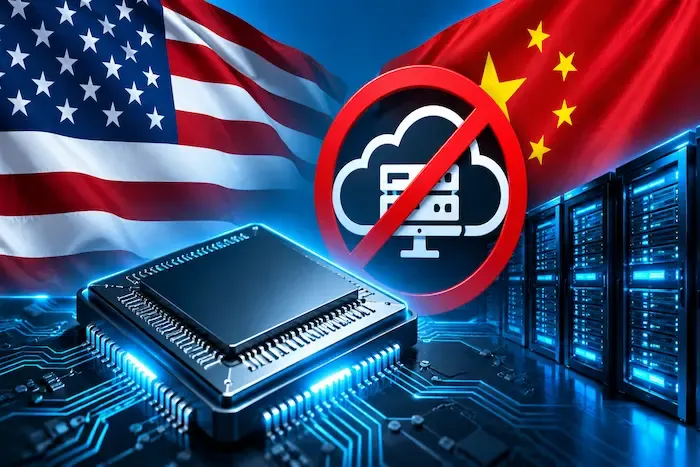
The Trump administration has imposed new restrictions that will stop Chinese AI companies from accessing high-end US tech via the web from data centres abroad. The Commerce Department said Monday, Nov. 16, 2026, it had announced the move due to a defect in the export controls it had left.
However, the new export restrictions from the United States also require export licenses from companies in Singapore, Thailand, Malaysia, Indonesia and Brazil for the powerful chips. This initiative follows President Donald Trump’s trip to Asia, where he will meet with Chinese President Xi Jinping. Washington faces growing pressure to make its semiconductor export restrictions effective.
Foreign Data Centers Are Impacted by US AI Chip Export Restrictions.
The new measure will focus on computing arrangements, meaning Chinese firms that process data on high‑tech American processors in a third country. Instead, companies can use the computing power of data centers, in countries without needing to buy limited chips.
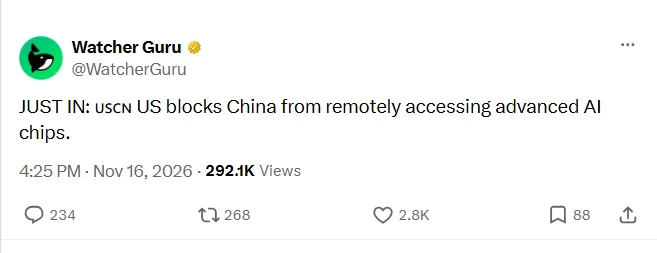
Source: Watcher. Guru
The restrictions are meant to stop current restrictions on sensitive U.S. technology from being circumvented by means of remote computing arrangements with facilities overseas, the Commerce Department said.
The United States has the Bureau of Industry and Security (BIS), which is in charge of enforcing US export controls, which also regulate semiconductor export limitations. The new one will feature access to computing hardware, not only to physical shipments of chips.
The U.S. ban on selling high-tech AI chips directly to China was lifted.The U.S. ban on direct sales of high-performance AI chips to China has been dropped. But the other problem with remote access via the data centers was one of enforcement.
To address this, the new restrictions are meant to provide clarity as to how overseas facilities make access to state-of-the-art U.S. computing power possible.
Further U.S. chip licensing stipulations for 5 countries.
New licensing requirements, including banning businesses in five countries (Singapore, Thailand, Malaysia, Indonesia and Brazil) from offering remote access, have also been imposed by the administration.
Companies in these areas would need to apply for U.S. export licences to get the most advanced chips under the measure. The stipulation is meant to minimize the chance of unauthorized processors diversion to China and other places.
A wider list of countries which might be impacted by wider semiconductor controls was discussed in previous reporting. Norway and South Africa were also part of the initial reports but the announced requirements are listed with the 5 countries in mind.
The difference is important because some of the proposals and consultations preceded the administration’s proposal.
Some of the restraints are based on concerns about access by Chinese firms to the use of foreign data centers that allow them to employ high-end foreign processors, specifically American processors, until China could export such processors.
China’s tech giants are being put on trial.
The restrictions have effects on China’s tech companies that have access to state-of-the-art computer systems outside of China.
According to sources, Tencent, Alibaba and ByteDance have signed deals with data centers that are located overseas, where they can make use of Nvidia’s most powerful chips for the training of AI models.
There has been an increased interest in such deals from both the U.S. and Chinese authorities. The US authorities are afraid that its technology is being made available to Chinese companies, albeit indirectly, while Beijing has been pushing for the use of locally produced semiconductor products.
The new export restrictions for U.S. AI chips are limited to the arrangements for remote computing that have made existing export restrictions more complex. They extend the law to not only include the ownership of chips but access through third-party computing infrastructures as well.
Some examples of “high-end hardware” previously reported and that would be impacted by the proposed restrictions are Nvidia’s Blackwell processors and later.
On Export Policy, Howard Lutnick Under Fire on Export Policy.
The announcement also comes on the heels of a criticism of Commerce Secretary Howard Lutnick, who was criticized on American semiconductor export controls.
Previously, it was reported that President Trump was urging for more stringent measures to stop advanced chips from being sold illegally to China. But it was reported that Lutnick was one of the biggest opponents of the proposed measure.
The battle highlights the policy challenges of access to state-of-the-art American semiconductors and limits on technology transfers to foreign companies.
Nvidia has voiced worries over the impact of more restrictions on its business relationships, which include cloud computing services firms and data center partners.
Conclusion
In the latest move by the U.S. government to extend the semiconductor export controls to include AI chips for “remote access” through data centers abroad, administration officials explained that in addition to seeking licenses for exports to five countries, it would also pursue
Frequently Asked Questions
Why is the US restrictive on China regarding access to advanced homegrown AI chips to be used within China?
By restricting the number of Chinese data centers that can gain access to advanced AI chips, US companies hope to prevent Chinese companies
What are the other countries that will be affected by the US chip licensing requirements?
The 5 countries specifically mentioned are Singapore, Thailand, Malaysia, Indonesia and Brazil.
Who is in charge of the restrictions in the USA?
The US export control regime is managed by the Commerce Department’s Bureau of Industry and Security (BIS).