
KEY INSIGHTS
- Circle recorded revenue of $1.4 billion during the first half and incurred USDC distribution and transaction costs worth $819 million.
- The settlement volume of USDC reached $36 trillion as the stablecoin’s transaction volume surged to 77% in June.
- The Circle is expected to enter 40 countries in Africa, Asia, Latin America, and Middle East to make USDC payments grow.
Circle has generated a revenue of roughly $1.4 billion in the first half of 2026 because of increased settlements through USDC and also in anticipation of expanding into 40 different markets.
The stablecoin provider has allocated $819 million for revenue sharing in distribution and transaction fees, alongside $473 million for infrastructure, according to the numbers presented by Odaily and the statements of Circle management.
The financials illustrate the expenses involved in the distribution of USDC and also in maintaining the services involved in its usage.
Circle USDC Revenue Reflects Distribution and Infrastructure Costs
Circle’s total first-half revenue of about $1.4 billion was spent in revenue share with distribution partners and fees totaling about 59%, or $819 million. Another $473 million was spent on infrastructure, which is about 34% of total revenue.
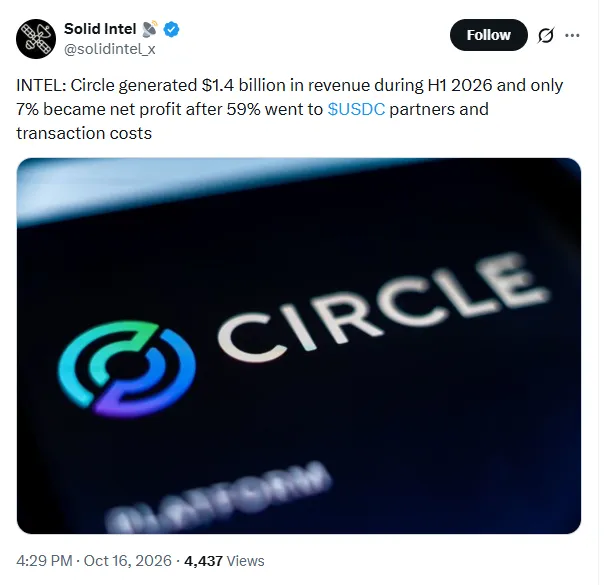
Source: Solid Intel
Circle used the infrastructure budget for expenses, including regulatory licensing, banking partnerships, settlement liquidity, compliance, and product development. Net profit represented about 7% of revenue during the period.
On October 16, Circle Chief Business Officer Kash Razzaghi discussed the company’s revenue-sharing arrangements in an official post. According to the model, distribution partners receive a certain share of the income reserved on the basis of their contribution to increased distribution of USDC.
Circle collaborates with more than 150 partners in the USDC ecosystem. Companies like Coinbase and Binance participate in its distribution model.
The framework ensures that collaboration is one of the key aspects of Circle’s business operations. Rather than viewing distribution as an entirely separate process, the company distributes its earnings with the firms that help boost the adoption rate of USDC.
USDC Settlement Volume Surpasses $36 Trillion Barrier
Circle has reported more than $36 trillion USDC on-chain settlement volume during the first half of 2026. The total issuance and redemption of USDC crossed $315 billion, averaging around $1.7 billion per day.
However, by June, USDC represented around 77% of the total transaction volumes of all stablecoins, compared to 60% in the prior year. While these numbers suggest an increased percentage of USDC transaction volumes, both transaction volume and circulation are distinct ways to assess stablecoin usage.
The circulation of USDC also grew in the second quarter. Per the reporting provided, USDC circulated at a value of $73.3 billion, a growth of 19% in year-over-year terms. However, another source placed the circulation of USDC at about $72.6 billion.
Circle allows customers to redeem USDC without fees through standard channels, with settlement typically completed within two business days. Eligible customers using Circle Payments Network and Circle Platform can also access free, near-real-time redemptions around the clock.
Circle Plans Expansion Into 40 Emerging Markets
Jeremy Allaire, the founder of Circle, explained that the company intends to reach around 40 markets in their stage of growth. These markets are comprised of Southeast Asia, Latin America, Africa, and the Middle East.
Allaire added that people in these markets are using digital currencies for transactions and remittance purposes. He added that the industry is evolving from being an early adopter to its next level of usage.
The expansion would place Circle in more direct competition with banks and payment companies operating in international money transfers. Earlier this year, Circle agreed to acquire Singapore-based payments firm Tazapay for $400 million. The deal is intended to provide access to banking and payment networks across more than 100 markets.
Circle has also received a reported $100 million strategic investment from Binance. The exchange signed a five-year commercial agreement with Circle in September.
Regulations and Payment Services Influence Strategy of Circle
Regulations represent yet another element of the expansion strategy of Circle. According to Allaire, the GENIUS Act of the United States expected to be introduced in January 2027 is an important event for stablecoin issuers.
Circle also reported receiving a federal banking charter in July. In Europe, the company became the first global stablecoin issuer to comply with the European Union’s Markets in Crypto-Assets Regulation.
The company is also developing payment infrastructure for transactions involving artificial intelligence agents. These programs can independently pay for information, data analysis and online services, with individual transactions potentially costing fractions of a cent.
Circle’s Arc blockchain infrastructure supports its broader payments strategy. Reuters identified BlackRock, Visa and Standard Chartered among companies using Circle’s solutions.
Allaire has also warned that automated systems and coordinated groups of AI agents could create additional security threats for financial infrastructure providers.
Frequently Asked Questions
What was the cost of distribution and transaction of USDC of Circle?
The cost of distribution partner revenue sharing and transaction fee for the USDC of Circle was $819 million, accounting for 59% of its first-half revenue.
What was the on-chain settlement volume of USDC of Circle?
USDC’s on-chain settlement volume from Circle topped $36 trillion in the first half of 2026.