
U.S. inflation was high in October, with the Personal Consumption Expenditures (PCE) price index rising 3.8% over the 12 months, and the American economy grew more than previously reported in the third quarter, by 4.3%.
Two economic trends are captured by the latest data from the Bureau of Economic Analysis (BEA), prices are going up and the economic growth is rapid. Inflation growth eased but underlying pressures continued to be higher than the Fed’s 2% goal, at least on the monthly level.
The gross domestic product (GDP) estimate was also bolstered by other factors, which have helped to provide background for the central bank as it prepares its interest rate decisions.
U.S. prices for personal consumption exceed Fed’s target.
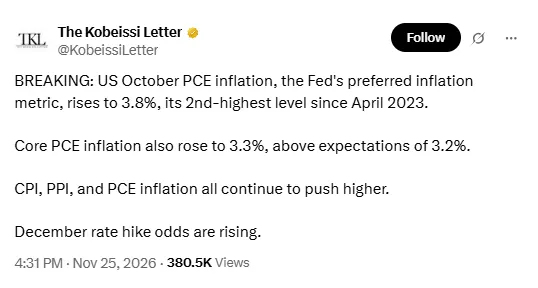
The headline inflation rate in the PCE rose 3.8% in October compared to a year earlier. This was consistent with economists’ forecast because the month-on-month rate of inflation had reversed but inflation is not yet coming to an end.
Source: Kobeissi Letter
The index increased by 0.3% in the month, after a 0.5% gain in September. The moderation suggests that the rate of inflation was slowing during the period though not to the level the Fed would prefer.
A more concerning index was core PCE inflation, which excluded food and energy. The figure came in at 3.3% for the year, higher than forecast and than the September reading of 3.1%.
On a monthly basis, core inflation increased by the same rate as a month ago, 0.3%. This indicated that price pressures continued, despite a slowing down in the headline monthly reading.
One indicator of the overall picture of inflation is the spread between headline and core inflation. The headline rise was anticipated while the larger-than-anticipated core reading indicated inflation continued to be solid in other areas of consumer spending.
Pressure for further Federal interest rate decisions is uncertain.
The Fed is still working to tame high inflation, the new US PCE data comes in. The concern about inflation has been recently put up as a priority, and the policymakers have to strike a balance between price stability and growth.
The central bank is expected to increase interest rates at its December policy review. It has already raised rates in October 2023.
The cost of borrowing could put the brakes on spending and economic demand which, in turn, could slow inflation. But even more restrictive monetary policy may have an impact on broader economic activity.
The uncertainty surrounding the extent to which policymakers may tighten monetary policy has further increased recently due to the volatility in the stock market linked to the developments in the world of artificial intelligence.
GDP grows at a faster pace, at 4.3%.
The BEA released its second estimate growth in the third quarter, when the rate of expansion was an annualized 4.3%, separately. This was an upward revision from the original 3.4% estimate and outpaced the 2.2% growth in the second quarter.
The growth came mostly from investment and spending by households here at home. Government spending also gave the economy a push. As government spending went up, investment growth went up too.
However, the good effects were partly cancelled by falling exports. Imports were also higher than in the quarter. Real final sales to private domestic purchasers, which include consumer spending and private fixed investment, rose by 5.8% (annualized rate), up from the previous estimate of 4.9%.
The economy got stronger in terms too. Real gross domestic income went up 4.4% from a year earlier, after 2.3% in the second quarter. Current production lifted profits by $206 billion. That comes on top of the $384 billion gain from the quarter.
Consumer spending and income are growing at rates.
Other data showed spending growth slowing down. It fell from 0.6% to 0.3%, which is under the 0.4% that economists had expected.
Household spending was held back. It still added some activity to the economy. Consumer spending has kept rising with higher living costs. This is thanks to the incomes of some households and a strong job market.
Personal income rose 0.7%, up from September’s 0.3%. Initial jobless claims also fell, to 189,000, while the four-week average changed little from the previous week to 196,000.
Gross domestic purchases price index rose at a 2.7% annualized rate, down from 3%, in the GDP report. PCE price index prices increased 2.1% and core PCE prices increased 2.5%. Both estimates were unchanged from a year ago. The price figures in these quarterly GDP releases will be different from readings in October.
Conclusion
The newest economic data indicate that PCE inflation is still above the Federal Reserve’s 2% target, despite the slowdown in monthly price growth. Meanwhile, in the third quarter GDP grew 4.3%, partly on the back of increased investment, consumer spending and government spending.
The stubborn persistence of inflation levels and the growth of the overall economy offer critical background to the Federal Reserve decision on interest rates in December.
Frequently Asked Questions (FAQs)
What was the U.S. PCE inflation rate in October?
Headline PCE inflation rose by 3.8% in the 12 months to October, as expected.
What was the value of the core rate of PCE inflation?
The inflation rate in core personal consumption expenditures was 3.3% on the yearly basis, compared to the forecast of 3.2%.
How much did the U.S. economy grow in the third quarter?
The second estimate of GDP by the BEA was 4.3% annualized.