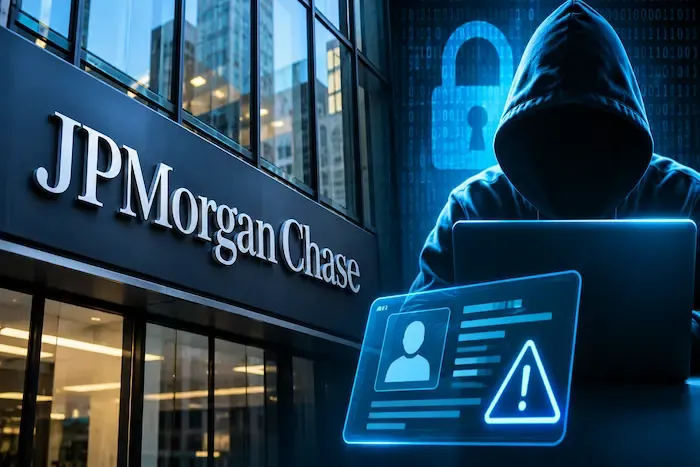
A cyberattack on the third-party service providers that interact with JPMorgan Chase has put some customer data at risk, the bank has revealed. US lender commented on Thursday, Nov. 19, 2026, to Reuters that the investigation revealed that the hackers had been able to get at marketing information kept by outside vendors.
The data might contain customer names and emails, though the bank hasn’t disclosed details on the extent of the exposure.
The revelation coincides with two separate online reports of customer data from JPMorgan Chase being leaked on the darknet. These reports have raised questions about how safe customer data is but the bank has confirmed that any data that could be accessed is only third‑party marketing data.
JPMorgan Chase is focusing on attacks against third‑party service providers.
The security breach was not a hack into JPMorgan Chase’s own banking systems, the firm said, but instead came from external parties that were servicing the financial institution.
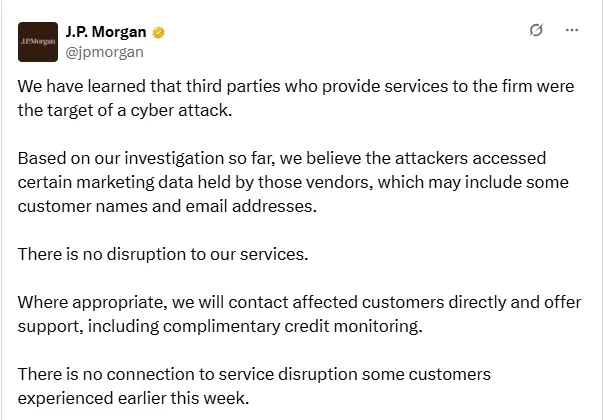
Source: JP Morgan
The bank’s spokesman said that investigators suspect the attackers gained access to marketing data that the vendors hold. But JPMorgan has not confirmed how many customers it’s impacted or identified the vendors.
The investigation continues as the basis for defining the specific information involved and the number of persons impacted.
Dark Web Reports raises new questions about data exposure.
Additional reports have now been issued, adding a layer to the incident. The ransomware group NoN shared some 16,000 email addresses of the company’s customers, as well as phone numbers and JPMorgan Chase identification numbers, according to information cited by Newsweek.
The reported information was termed linked to the bank’s reserve program. But these assertions are not the same thing as JPMorgan’s official statement regarding the attack by the third party vendor.
The bank said in the information it supplied that it did not confirm the records in the dark web reports were related to the same incident. It has also not determined if the information reported has been related to the marketing data found during its investigation.
These reports have raised a concern about the possibility of exposing customer information beyond the names and e-mail addresses noted by the bank. Reported numbers and identification information may contain other information regarding people connected to the institution.
However, it cannot be determined from the information available that all of the published records are valid or that they came from the vendor incident.
The bank says that the attack was not on its systems but rather a fraudulent transaction.
The disclosure comes after a different type of tech glitch that hit JPMorgan Chase last week. The bank had to deal with the software bug, which also affected other financial institutions, to process transactions.
JPMorgan explicitly denied that the connection with the third-party cyberattack and the disruption were related. This is important because the two events were caused by different reported reasons. The transaction processing issues were blamed on software, and the security incident just announced was caused by third parties and could have led to the disclosure of marketing data.
Other technology-related disruptions are also coming under the spotlight in recent times. A nationwide Federal Aviation Administration ground stop disrupted air travel last week, and Microsoft had an email outage across the world.
These incidents have come in the wake of general concerns that interruptions are an issue to major technology-dependent services.
The U.S. banking regulators consider recent disruptions.
The banking turmoil earlier also brought inquiries from the US financial regulators. Lenders were asked by the Office of the Comptroller of the Currency (OCC) questions after processing issues arose, according to people told by Reuters. The regulator sought to learn about the effect of the disruption and how banks were trying to inform customers.
According to Reuters, the Treasury Department and OCC contacted banks immediately after it was reported to them to gauge if the issue had been contained and whether it involved any cybersecurity concerns.
The OCC routinely performs this type of examination after the events of this kind, the Reuters added. These regulatory inquiries were, however, connected with the earlier disruption of the service. They should not be read as a sign of an independent investigation of the recently revealed vendor breach.
Conclusion
With the JPMorgan Chase cyberattack in the news, there is a concern that third party service providers may have access to customer marketing data. While the bank has only listed affected customer names and email addresses, individual dark web reports have brought in other accusations of phone numbers and ID information. JPMorgan will reach out to affected customers directly, but the extent of data exposure and whether the reported incidents are linked or related have yet to be verified, the bank says.
FAQs
What went wrong in the JPMorgan Chase cyber attack?
In a cyberattack, JPMorgan Chase’s third-party service providers were attacked. The bank says it thinks the attackers got access to marketing data that it stores with those vendors.
What form of customer data could have been breached?
JPMorgan said it could have identified the names and email addresses of its customers as potentially affected. There were also separate reports of the release of telephone numbers and bank identification numbers.
Which organization is the ransomware group in the reports?
The group in the Newsweek article is NoN, which was alleged to have sold about 16,000 email addresses for customers in addition to other data.