XRP Ledger Foundation has gone through the Global Layer One (GL1) Market Infrastructure Toolkit and is now the first public, permissionless layer-1 blockchain to be independently assessed for their architecture and resiliency principles.
The Foundation checked the ledger for compliance with all 10 principles; blockchain security company CertiK reviewed evidence related to the architecture and resiliency aspects and provided an independent attestation report dated 13 November 2026.
It serves as a framework with which banks and asset managers can undertake due diligence for tokenized financial infrastructure. It does not certify meeting all of the GL1 standards.
The XRP Ledger GL1 Verification covers the following.
The GL1 Market Infrastructure Toolkit offers a standard set of instruments that can be used to evaluate digital financial infrastructure. It is based on the Principles for Financial Market Infrastructures (PFMI), the Digital Asset Securities Control Principles, and the Global Blockchain Business Council Risk Mitigation Framework.
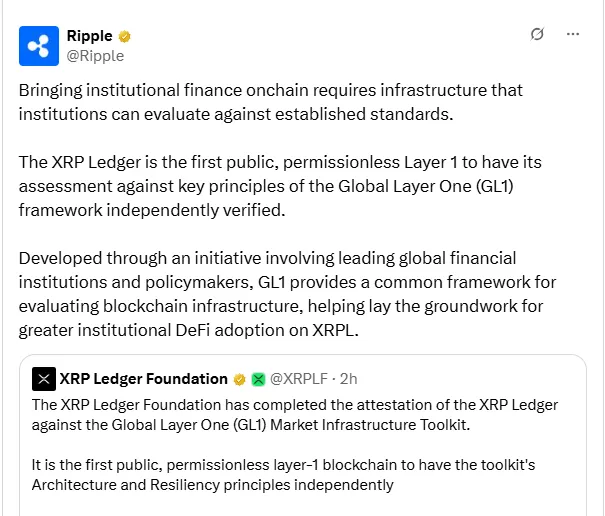
Source: Ripple
The XRP Ledger Foundation completed a self-attestation of all 10 principles and provided evidence for all controls. Under the principle of architecture, CertiK checked the responses and supporting evidence from the Foundation under the principle of resiliency. The independent verification mentioned in the announcement is found in its report that was released on November 13.
The scope is important: The Foundation reviewed all 10 principles, but the independent review discussed in the material was on architecture and resiliency. GL1 assessments can determine if controls are observed, partly observed, not observed, or not applicable. The completion of an assessment does not imply compliance with GL1 standards.
The Framework in Relation to a Public Blockchain
There are some controls that are intended for one operator of a private or permissioned network. The Foundation provided a list of comparable protections in the design, governance and amendment process of the XRP protocol and compliance capabilities to issuers and institutions for controls that it does not believe are directly applicable to the open-source, permissionless nature of the XRP Ledger.
The key is that institutions require proof in a format that aligns with the standards they already know and trust in terms of risk and compliance, according to Brett Mollin, Executive Director of XRP Ledger Foundation.
He said the toolkit was a shared framework to present that evidence and thanked the GL1 Market Infrastructure Working Group for making it usable by public and permissioned networks.
The GL1 Institutional Context and Other XRPL Disclosures are available to download.
The XRP Ledger features on the GL1 toolkit which includes other top-tier networks such as Solana, Base and Kinexys. The Global Layer One Organisation (GLO), an early November collaboration between HSBC, Kinexys (part of JPMorgan), MUFG, Societe Generale-FORGE, and Standard Chartered, was founded in Singapore. The Monetary Authority of Singapore (MAS) originally led the initiative.
Other network disclosures are relevant context, but the GL1 review is not the same as other disclosures. In October, the XRPL release notes mentioned two transaction validity and payment calculation issues.
According to Ripple, versions 3.4.1 and 3.4.2 contain patches for the above-mentioned issues. An amendment to the security committee to prevent unauthorized tokens was reported as active on Nov. 4.
The XRP Ledger documentation also details software reviews, bug bounties, and signed releases. On November 16, a prototype Metrika dashboard for monitoring the finality of the settlement, GL1 indicators, such as the availability of the network and the level of validator concentration, as well as the costs of transactions was made available.
Conclusion
The XRP Ledger Foundation has evaluated the network in a standard institutional review process. It has self-attested on all 10 GL1 principles, and CertiK has been independently verifying evidence on architecture and resiliency. This process is not only a structured reference for institutional due diligence but also does not provide blanket affirmation of GL1 compliance.
The Foundation noted that it plans to update the assessment as the toolkit continues to be developed and new changes to the XRP Ledger are put into effect.
FAQs
What is GL1 Market Infrastructure Toolkit?
It is an evaluation framework established by the GL1 Market Infrastructure Working Group that evaluates digital financial infrastructure based on 10 principles based on international standards and industry frameworks.
What did CertiK prove?
CertiK has analyzed Foundation’s responses and supporting evidence pertaining to the architecture and resiliency principles. It was published on November 13, 2026.
Did the XRP Ledger meet all the 10 principles without relying on any party?
The Foundation has made a self-attestation in relation to the 10 principles. According to the material, CertiK’s independent review was conducted on architecture and resiliency.