
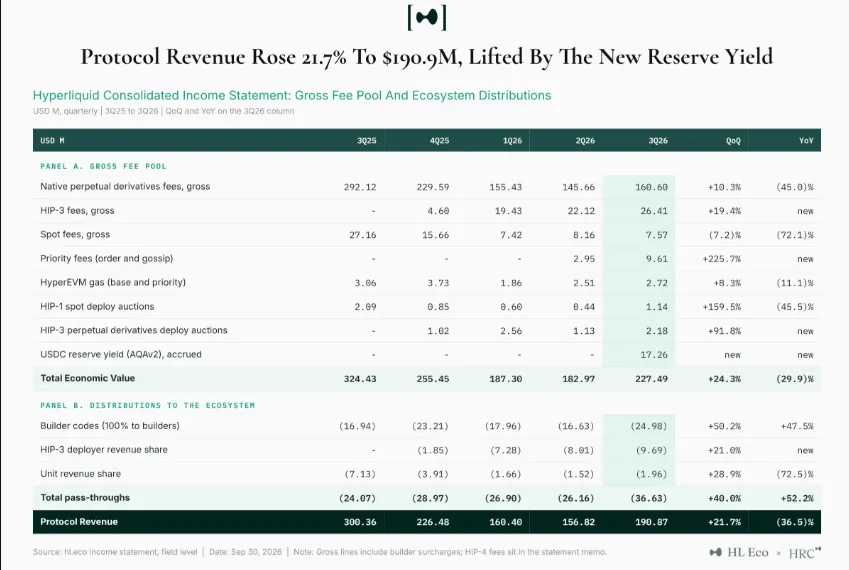
The protocol’s revenue in Q3 2026 came to $190.9 million, which is 21.7% higher than in Q2 2026. The findings, according to Hyperliquid Research Collective (HRC), were the highest in terms of revenue for the protocol in the third quarter, but it was still 36.5% less than in the same quarter last year.
While trading activity remained a revenue stream, a new one made a significant impact as well. Hyperliquid began to produce revenue from the yield of the USDC reserves starting at August 27—providing the company with $17.3 million in revenue for the quarter. This sum represented almost half of the increase in quarterly revenues.
The time also saw increased priority fees, record daily trader activity and some $149 million in purchases in the Assistance Fund via HYPE. These all help to provide a clear understanding of the performance of Hyperliquid with regards to Q3.
Where is the $190.9M in Q3 revenues from Hyperliquid from?
The increase in Hyperliquid Q3 was driven by multiple factors, none of which included a change in trading volume. Other sources of protocol income were reserve income, and perpetual futures trading remained a key source of income.
Source: Wu Blockchain
The “reserve” feature was vital for the USDC, as it provided a way for an income stream that didn’t necessarily rely on traders completing trades. Hyperliquid began to receive share of reserve yield on August 27. It generated $17.3 million for the final four weeks of the quarter.
It constituted almost half of the quarter-on-quarter revenue growth. It also implied that the protocol would make income not only with the profits of the stablecoins in its reserves, but also due to the trading fees.
As per the other report, the amount saved is from the AQAv2 relationship with the USDC in Hyperliid.
But the new source of income is not enough to compensate for the fact that overall Hyperliquid’s income remained lower in the third quarter as compared to last year. The progress in the quarter was not enough to make up for the difference of 2025, as demonstrated by the 36.5% annual decrease.
What is causing the priority fees to go up?
Priority fees was another development during the quarter. Hyperliquid said that it would generate $9.6 million from these fees, a nearly 3.3 times increase in the Q2 reported fee amount.
Users pay priority fees to get the fastest transactions. Their introduction into the protocol didn’t come with any direct relation to the fees charged for trading on the protocol.
There was also a positive correlation with the growth and user activity. This is the highest average number of active traders for an average day in Q3, compared to Hyperliquid’s history.
In the meantime, the number of payments made at the priority fee has risen but so has the number of traders. Nonetheless, the figures do not reflect the percentage of the increase in priority fee caused by the increase in the number of traders per day.
There were several events that have contributed to the result for the quarter as evidenced from the trading fees and reserve income.
How did HYPE’s buybacks affect the Q3 profit?
The Assistance Fund of Hyperliquid had been very active for the quarter, as it bought HYPE tokens worth $149 million.
Part of the protocol fee will be dedicated to the fund and the fund will be buying the protocol from the market. The purchases are due to the token buy-back system in the protocol.
An indicator of the fund’s activity for Q3. However, it is important to note that money that is spent on purchases is not protocol revenue. Buybacks are not meant to be a profit-making scheme but rather a means of using the funds.
Conclusion
According to Hyperliquid, the revenue for Q3 reached $190.9 million, due to trading activities and USDC Reserve yield & priority fees. The creation of the income from reserves was the source of almost 45% of income increase in the third quarter, with the creation of almost $17.3 million.
Other indicators were the number of daily transactions on the platform by traders and the number of transactions made by the Assistance Fund. Other factors included the number of traders trading on the platform in a day and transactions of the Assistance Fund.
The revenue decrease year-on-year was, however, 36,5% compared with the smaller revenue increase for the quarter.
FAQs
How much are Hyperliquid’s revenues in Q3 2026?
The protocol revenue earned for the third quarter of 2026 was $190.9 million, indicating an increase of 21.7%.
What would be the yield earned from the USDC reserves?
USDC reserves started earning yields on August 27, 2026, which amounted to $17.3 million of yield.
What would be the total cost incurred by Hyperliquid to buy the HYPE?
The cost of HYPE tokens is approximately $149 million in the third quarter.