

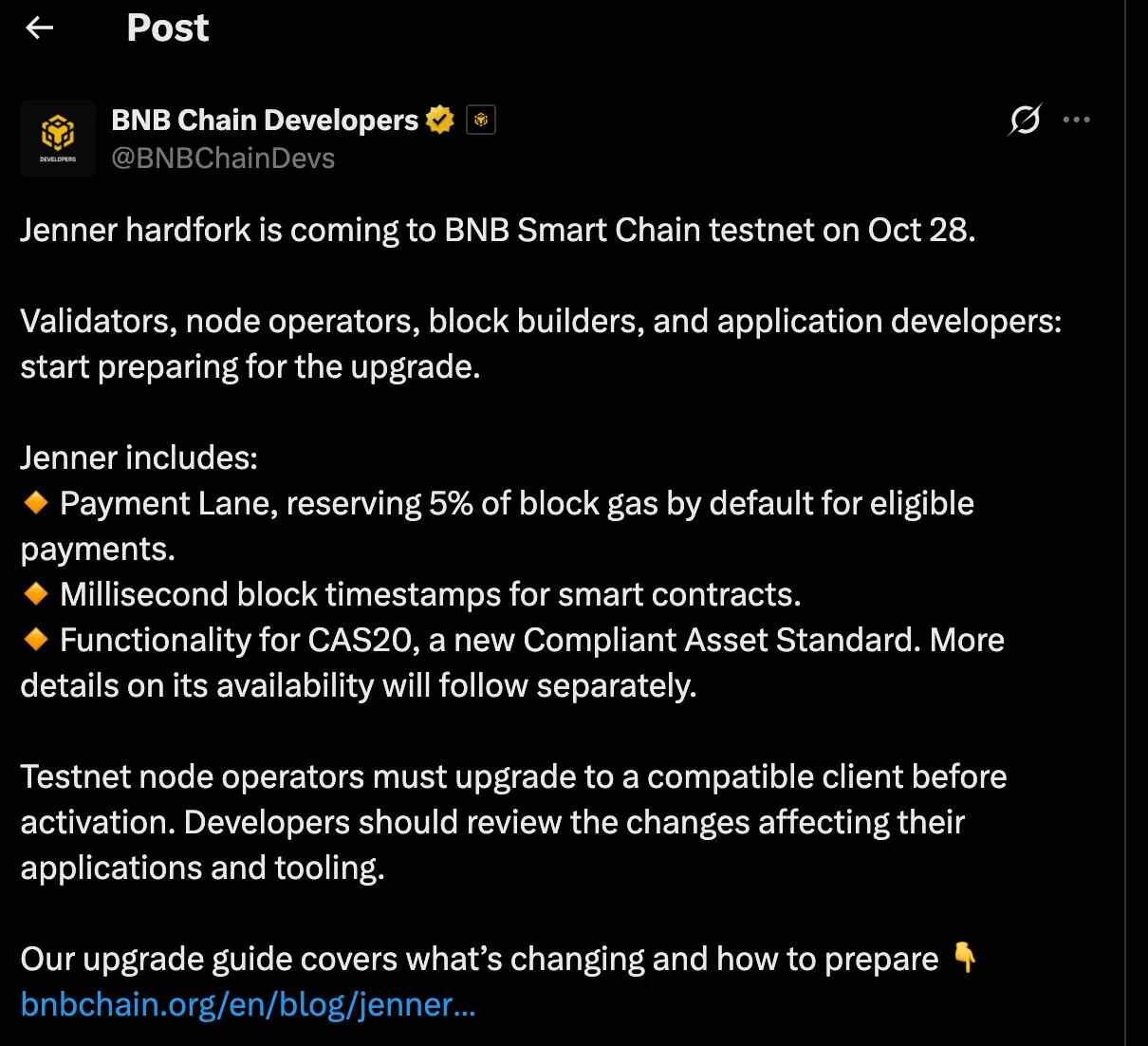
BNB Chain will test its upcoming Jenner upgrade on October 28, introducing changes to payment processing, token controls and the way smart contracts handle time.
The network announced the update on October 22 and asked validators, node operators and developers to prepare their systems. The upgrade will first run on the BNB Smart Chain testnet. A mainnet launch date has not been announced.
Jenner will introduce three main changes. One will set aside part of each block for eligible payments, while another will give token issuers more control over transfers. Developers will also gain a new way to read timestamps with millisecond precision.
 Source: X
BNB Chain to Reserve Block Space for Payments
The upgrade includes Payment Lane under BEP-703. The feature will initially reserve 5% of each block’s gas capacity for qualifying transactions. Network governance can increase that share to 10%.
In practice, the change gives certain payments space that ordinary transactions cannot use. Eligible transfers will include BNB payments to accounts without smart contract code and payments processed through approved contracts.
However, not every stablecoin transfer will qualify. The list of approved contracts will start empty, meaning stablecoin and CAS20 projects must receive governance approval before using the reserved capacity.
There is also a limitation. If no eligible payments need the space, other transactions cannot use it. Qualifying payments can still use the remaining block capacity, but the feature does not guarantee instant confirmation or lower transaction fees.
CAS20 Gives Token Issuers More Control
Jenner will also introduce the framework for CAS20 through BEP-702. The proposed standard is designed for digital assets such as stablecoins and tokenized real-world assets.
Under the standard, issuers can set rules governing who may hold or transfer their tokens. They can restrict transfers to approved users, block specific addresses or pause transfers when necessary.
The framework also separates permissions for creating tokens, destroying them and seizing assets. These controls could help issuers manage tokens that require restrictions on how they move between wallets.
Projects will not gain access to these features automatically. An administrator must activate token creation and enable changes to the policy registry before the controls can be used.
BNB Chain said it would provide further details about CAS20 availability and integration in a separate announcement. The standard will also retain functions and event notifications compatible with existing BEP-20 tools, which should make integration easier for developers.
However, technical compatibility does not mean a token automatically meets legal or regulatory requirements.
New Function Lets Smart Contracts Read Milliseconds
Another change comes under BEP-706, which adds a built-in function for reading timestamps in milliseconds.
The function, available at address 0x70, will give developers a more precise time reading when building applications on BNB Smart Chain. The existing block.timestamp function will continue to return time in seconds.
The difference could be useful for applications that depend on tight deadlines. A trading platform, for instance, could use millisecond readings when checking whether a quote has expired. Auctions and price-feed systems could also use the added precision.
The change does not make blocks arrive faster or guarantee more accurate timestamps. It simply gives developers another option when their applications need finer time measurements.
Node Operators Must Check Client Requirements
Developers and node operators will also need to check their software before the testnet upgrade.
Chapel testnet operators running Reth should install reth-bsc v0.1.3, while those using BSC Geth should follow the upgrade instructions for their client.
Reth users must also account for a change affecting RPC requests, which applications use to communicate with the blockchain.
For eth_call and eth_estimateGas, developers must pass the remaining milliseconds through blockOverrides.prevRandao. The field requires a 32-byte hexadecimal value representing a number between zero and 999. The main timestamp will remain in seconds.
The Reth release also includes changes to block-building tools under BEP-675. These cover gRPC-based bid submissions, improved validation and builder revocations that remain in place after a restart. Those changes are separate from the Jenner hard fork.
BNB Smart Chain’s previous major upgrade, Pasteur, reached mainnet on August 25. It introduced changes to bridge verification, validator authorization and block building while retaining the network’s 450-millisecond block time.
For now, developers and node operators have October 28 as their next deadline. Jenner will first be tested on BNB Smart Chain’s testnet, with the mainnet rollout still to be announced.