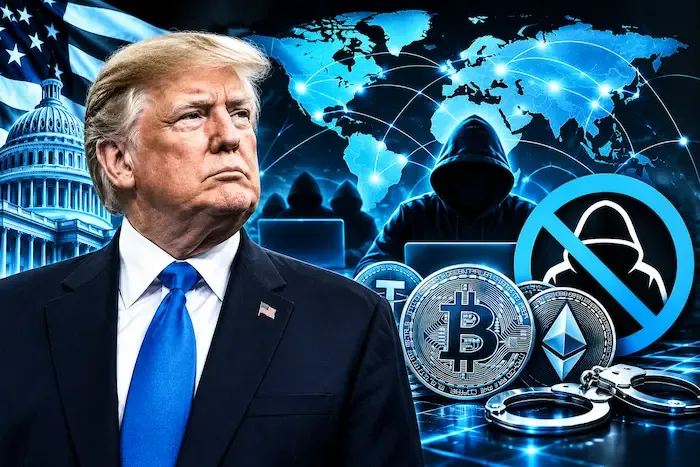
President Donald Trump is set to announce further action against overseas cryptocurrency scams at the White House on Wednesday. The effort targets fake investment websites, online impersonation and criminal groups that take money from Americans. Federal authorities have already seized websites and cryptocurrency tied to suspected fraud, as losses from online crime continue to mount.
Trump Expands Crackdown on International Fraud
Several senior officials are expected at the White House event, including Homeland Security Secretary Markwayne Mullin, FBI Director Kash Patel, Defense Secretary Pete Hegseth and Attorney General Todd Blanche, a White House official said.
The FBI received more than one million internet crime complaints in 2025, up 17% from the previous year. Its annual report also showed record losses among people who reported crimes.
The administration’s fraud campaign comes as Trump faces questions about his own crypto businesses. A Reuters investigation found that Trump and his sons added at least $2.3 billion to their family fortune through cryptocurrency ventures. The investigation also reported $2.3 billion in losses among investors attracted to those ventures.
White House spokeswoman Anna Kelly defended the administration in response to the report. “All actions by President Trump and his administration are taken in the best interest of the American people,” she said.
Trump also pardoned Binance founder Changpeng Zhao in October 2025. Zhao had stepped down after Binance pleaded guilty to failing to maintain an effective anti-money laundering program.
Federal Agencies Pursue Overseas Scam Operations
Trump signed Executive Order 14390 on March 6, 2026, directing federal agencies to draw up a plan to combat criminal organizations running scam centers across national borders.
The order also asked the attorney general to recommend a way to compensate victims using money seized from criminal groups. That could allow some recovered funds to go toward people who lost money in the scams.
A second directive, issued on August 12, addressed foreign cybercrime groups. It called on the National Coordination Center to develop rules for approved American companies conducting cyber surveillance and disruption operations under federal oversight.
The Scam Center Strike Force has also taken on a central role in the campaign. U.S. Attorney Jeanine Pirro launched the unit on November 12, 2025, alongside the Justice Department, FBI and Secret Service.
The team investigates cryptocurrency investment scams linked to compounds across Southeast Asia. These operations use fake websites and promises of high returns to convince victims to send digital assets.
On September 9, 2026, the strike force and Treasury Department took action against Xinbi Guarantee, a Chinese-language marketplace on Telegram. Authorities alleged that vendors offered fake investment websites, money-laundering services and recruitment services for scam compounds.
The operation resulted in the seizure of Telegram channels and restrictions on about $52 million in cryptocurrency. The strike force’s total restrained funds later reached roughly $938 million.
The unit has also worked with authorities in Madagascar to dismantle 13 Chinese-run scam compounds.
Investigations Show the Cost of Crypto Fraud
The crackdown extends to fraud schemes that use social media advertisements and fake investment platforms to reach potential victims.
On October 14, Brooklyn District Attorney Eric Gonzalez said his office’s Virtual Currency Unit had worked with the FBI to disrupt 241 scam websites and 112 servers.
The three-year investigation examined a multinational operation that targeted Russian-speaking Americans through Russian-language Facebook ads. According to the allegations, scammers later contacted victims again with false offers to recover their stolen money. Authorities have not announced any arrests.
Federal officials are also examining financial records for signs of investment fraud. On September 3, the Financial Crimes Enforcement Network analyzed 33,904 suspicious activity reports filed between September 2023 and December 2025. The reports linked about $12.7 billion in financial activity to suspected digital asset investment scams.
Banks and other financial institutions can help investigators follow the money by reporting transactions they consider suspicious. Those records can provide leads when authorities try to identify fraud proceeds and determine where the money went.
In July, the Justice Department announced cryptocurrency seizures worth more than $25 million across five investigations involving victims in the United States and Canada. The cases brought reported recoveries associated with the Scam Center Strike Force to more than $800 million.
Private companies have also contributed to investigations. Coinbase participated in an international operation against West African fraud networks from October 6 to 9, working with the U.S. Justice Department, Britain’s National Crime Agency and private-sector investigators.
Coinbase said its investigators traced transactions and shared information with law enforcement. Investigators used that information to help identify suspicious accounts and disrupt fraud networks operating across borders.
Crypto Enforcement Faces Political Questions
The crackdown is unfolding alongside a wider debate over cryptocurrency regulation and investor protection in the United States.
A Reuters report said potential Democratic gains in Congress could bring closer scrutiny of crypto companies, prediction markets and financial regulators. If Democrats take control of either chamber, they could use hearings and subpoenas to investigate administration policies.
Such a shift would not automatically overturn existing regulatory decisions. However, additional congressional investigations could create new challenges for companies already dealing with changing rules.
State officials have raised separate concerns about the Digital Asset Market Clarity Act. In September, New York Attorney General Letitia James joined 18 state attorneys general and the District of Columbia in urging senators to preserve state enforcement powers.
The officials warned that unclear provisions could limit states’ ability to investigate crypto scams and prosecute suspected offenders. They asked lawmakers to protect existing powers under securities and commodities laws.