
The AI governance strategy proposed by Anthropic has found its way into Capitol Hill, where U.S. lawmakers have been presented with a bill that is yet to be published and that is aimed at limiting the instances in which federal regulators can interfere with powerful AI systems. According to a report by POLITICO on October 16, 2026, this strategy sets thresholds for financial and harm-to-humans interventions.
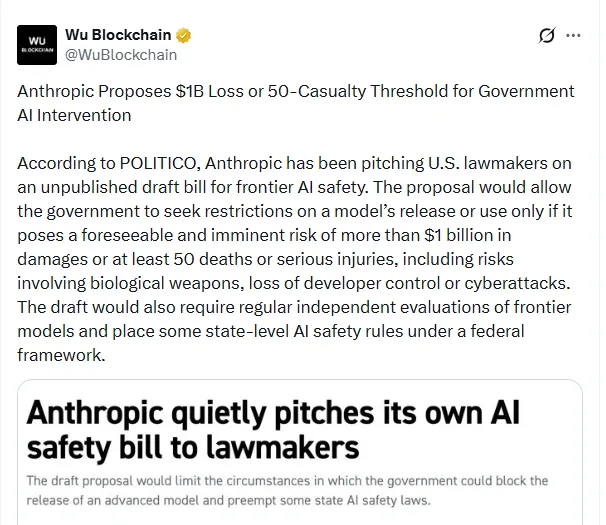
Under the draft, restrictions could be sought when an AI model presents a foreseeable and imminent risk of causing more than $1 billion in damages or killing or seriously injuring more than 50 people.
Source: Wu Blockchain
The qualifying threats would involve biological weapons, a model circumventing its developer’s controls or cyberattacks. Furthermore, it would also lead to a change in the way the government shares responsibility with state authorities when it comes to oversight of AI safety.
The bill is still a proposed piece of legislation that has not been passed into law. The sections of the bill represent the regulatory framework that Anthropic hopes Congress will consider.
How the Anthropic AI Safety Bill Would Limit Government Powers
The proposed criteria would define conditions necessary for the government to consider seeking to restrict the use or release of an AI model.
Instead of allowing broad authority to restrict development, the draft criteria tie intervention to particular risks and levels of harm.
The financial threshold is in excess of $1 billion. The alternative concerns more than 50 deaths or serious injuries. Either threshold would need to be connected to a qualifying threat, according to the reported draft. These figures describe the proposed intervention criteria, not evidence that a particular AI model has caused damage at either level.
The proposal also identifies a specific route for seeking restrictions. Under the reported language, the Commerce Department could ask a federal judge in the District of Columbia to suspend a model after determining that the relevant risk exists. Other federal departments, agencies, and officers would be barred from independently suspending a model’s development, deployment, or internal use under the draft.
This arrangement would place the decision within a defined judicial process rather than leave separate agencies with independent suspension powers. The proposal does not mean that every risk involving an advanced AI system would automatically qualify for government intervention.
Independent Assessments Would Identify Serious AI Risks
The Anthropic AI safety bill would introduce external evaluations of AI laboratories and their frontier models. Evaluators would register with the Commerce Department and periodically examine the companies and systems covered by the proposal, according to Reuters’ October 16 report.
AI developers could pay for these assessments, but compensation could not depend on the evaluator’s findings. That condition would separate the payment arrangement from the outcome of an assessment, although the draft’s practical implementation would depend on the final legislation.
The proposal would also establish a reporting deadline for serious findings. Evaluators who identify an imminent risk within the specified categories would have to notify the Commerce Department within 72 hours of completing their assessment. This would give the department a formal channel for receiving information about qualifying threats.
Anthropic has separately published its Advanced AI Framework, dated June 2026, which advocates external evaluations and stronger reporting practices for frontier AI developers. Its framework provides context for the company’s regulatory position, but it should not be confused with the unpublished bill presented to lawmakers. Anthropic’s framework sets out the company’s broader recommendations.
Federal Oversight Would Affect State AI Regulation
The proposal would also establish federal oversight that supersedes some state-level AI safety requirements. This provision addresses which level of government would set rules for the risks covered by the legislation.
Adoption of such an approach would constrain some of the state regulations in respect to the spheres controlled by the federal framework. Nonetheless, there is no indication from the reports that all state AI regulations would become unnecessary or which particular rules would be subject to the restrictions mentioned above.
The difference is significant since the draft aims to achieve two purposes, it defines when the government can regulate the AI model and what institutions have the right to do so. Its federal framework would cover specified safety concerns rather than automatically resolve every question surrounding AI regulation.
What the Proposal Means for AI Safety Oversight
An Anthropic spokesperson told POLITICO that the bill reflected proposals in the company’s Advanced AI Framework, which it had advocated for with federal and state lawmakers since June.
The spokesperson said the company believed Congress should adopt the policies. According to Reuters, however, Anthropic and the Commerce Department have not yet responded to their requests for comments.
The proposal is thus the suggested plan of action on how the federal government should oversee the use of artificial intelligence. The key aspects are intervention thresholds, judicial review, independent assessments, and federal-state jurisdictional boundaries.