
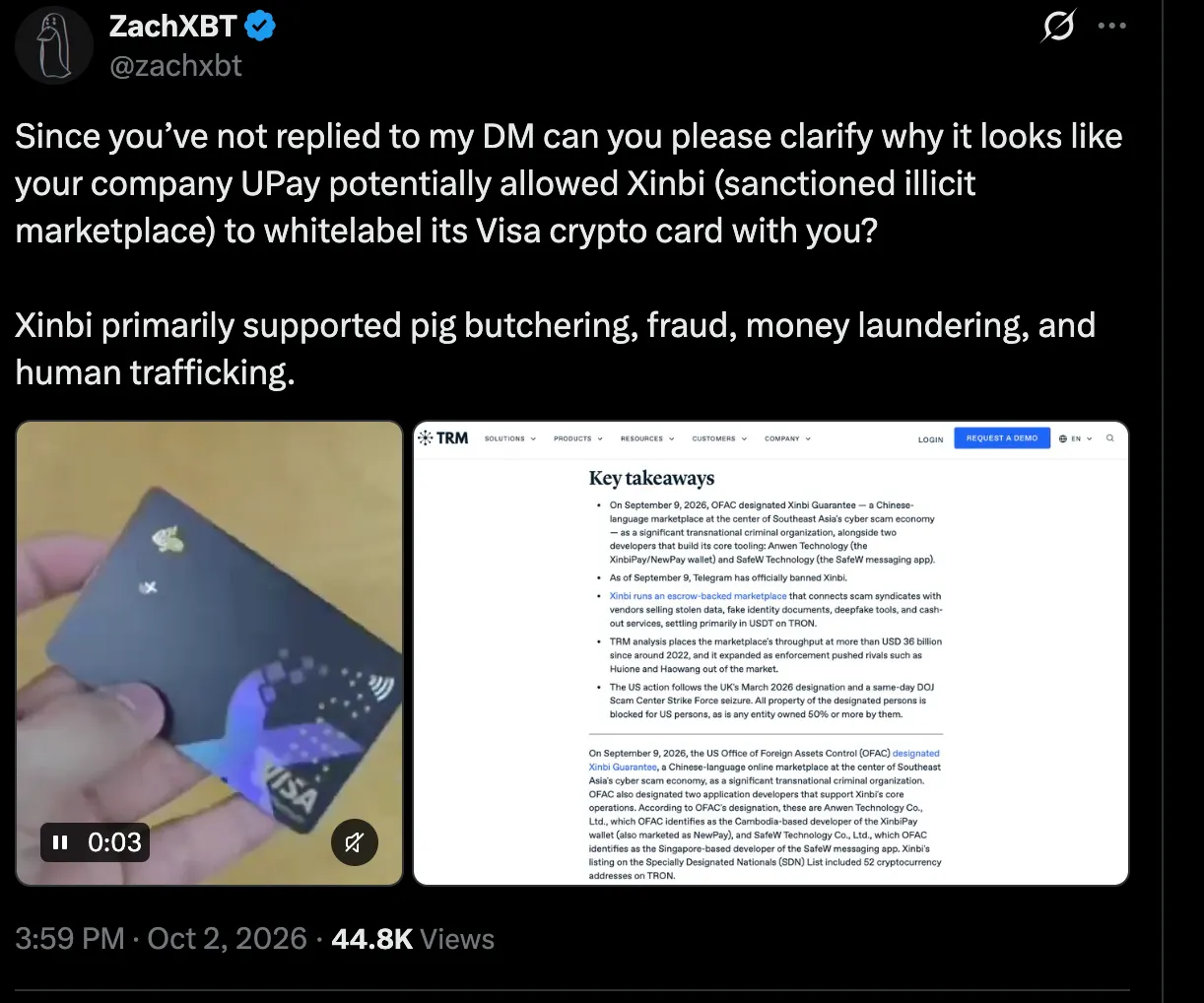
Blockchain investigator ZachXBT has raised questions about a possible link between UPay and Xinbi Guarantee, a crypto marketplace sanctioned by the U.S. Treasury.
He raised the issue on October 2 after saying UPay co-founder and CEO Owen Yang did not reply to a private message. ZachXBT asked whether Xinbi had used UPay’s services to offer a Visa crypto card.
Source: X
No Confirmed Xinbi Card
There is no public evidence confirming that Xinbi launched a Visa card through UPay.
UPay offers crypto cards and white-label services that allow other businesses to put their own names on card products. Its public website does not list Xinbi as a customer or partner.
ZachXBT questioned whether the two had a business relationship. In his post, he also pointed to allegations involving Xinbi and scams, fraud, money laundering and human trafficking.
That does not prove that UPay worked with Xinbi.
UPay had not publicly answered ZachXBT’s claims at the time of reporting. Yang had also not responded publicly.
The company offers virtual and physical cards that can be used through Visa’s network. Customers can fund them with cryptocurrencies including Bitcoin, Ether, USDT and USDC.
UPay Offers White-Label Cards
UPay’s white-label service allows another company to offer a crypto card without building the entire system itself.
The cards can carry the partner’s branding, while UPay provides much of the technology behind them. That can include the systems used to issue cards and connect them to payment networks.
This type of setup also means providers have to know who their partners are. Financial crime checks and sanctions screening can become particularly important when a service is offered to businesses in different markets.
That is part of what makes ZachXBT’s question notable.
But UPay’s public information only shows that it offers these services. It does not show that Xinbi used them.
Xinbi Was Sanctioned in September
The allegations against UPay came weeks after U.S. authorities sanctioned Xinbi.
The Treasury Department’s Office of Foreign Assets Control designated Xinbi Guarantee on September 9. OFAC said cybercriminals used the platform for scams, fraud, money laundering and other criminal activity.
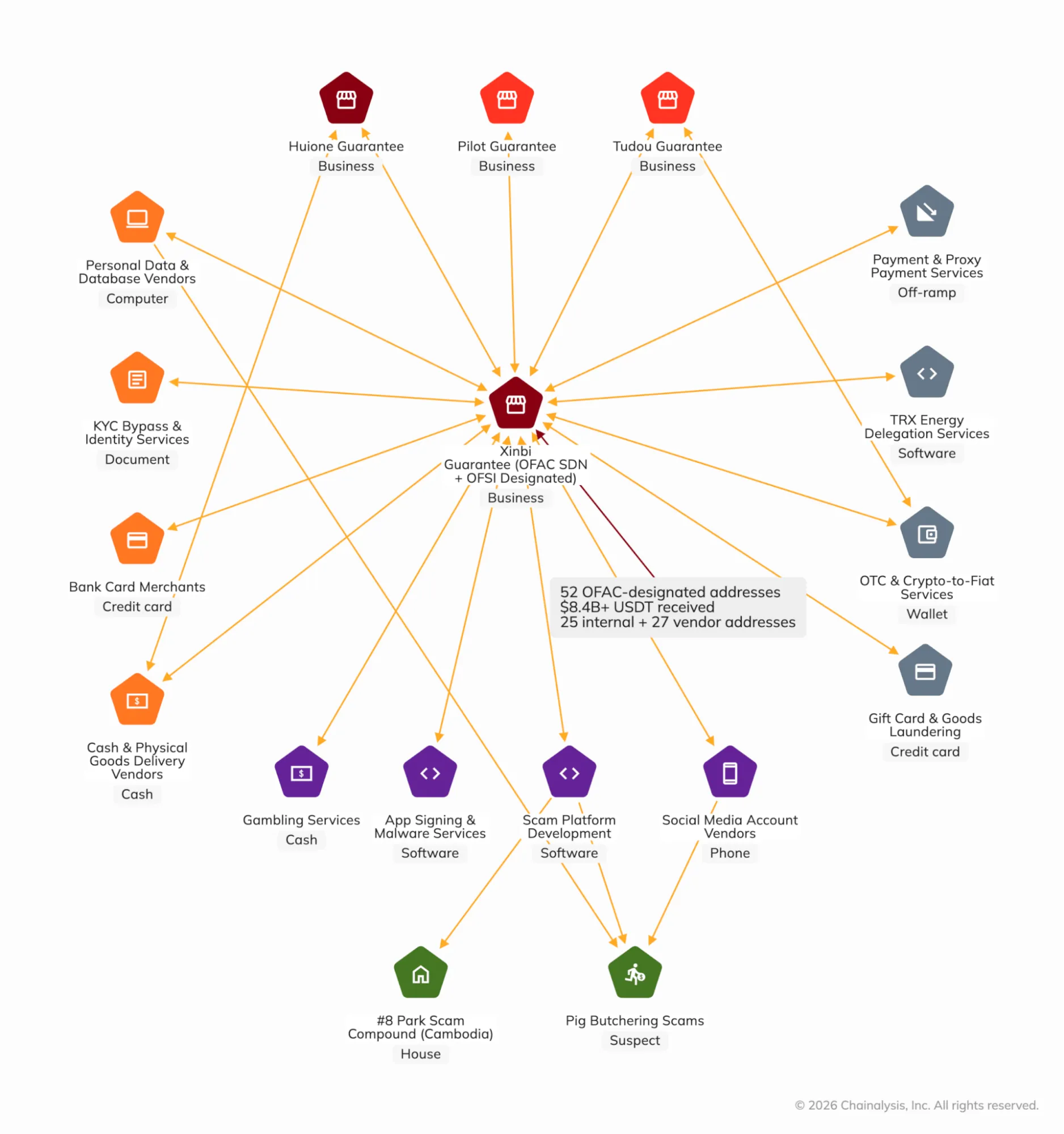
Xinbi Guarantee’s on-chain ecosystem, Source: Chainanalysis
OFAC also sanctioned Anwen Technology and SafeW Technology, which it linked to Xinbi. The action included numerous crypto addresses, including ones on TRON.
Separately, the Justice Department said its Scam Center Strike Force had restrained more than $52 million in cryptocurrency tied to Xinbi and its network.
The DOJ described Xinbi as a Telegram-based marketplace where vendors allegedly sold services to scam operators. Those services included crypto laundering and fake identities. The department also said vendors used the platform to recruit workers for scam compounds in Southeast Asia.
Why Crypto Card Providers Face Questions?
Crypto cards let people spend digital assets at regular stores. With a white-label service, another company can put its own name on the card while a third party handles the technology.
That setup makes the relationship between the companies important. A provider needs to know who it is working with and how its card system is being used.
ZachXBT has investigated crypto hacks, scams and suspicious transactions before. This time, he went public after saying Yang did not respond to a private message.
So far, there is nothing public showing that Xinbi used UPay’s card system.
UPay-Xinbi Relationship Remains Unclear
The connection raised by ZachXBT has not been confirmed.
UPay offers white-label crypto card services, while ZachXBT is questioning whether Xinbi used them. Neither UPay nor Yang had publicly responded at the time of reporting.
There is also no public confirmation that Xinbi was a UPay customer or that UPay issued a card carrying Xinbi’s name.
For now, the companies’ alleged relationship remains unanswered.